Weekly Updates – CMHAM – Community Mental Health Association of Michigan
Page Restricted to: All Members

Weekly Update November 7, 2025

Association and Member Activities

Another successful CMHA Fall Conference

CMHA recently concluded its 2025 Fall Conference – one of three annual conferences in which hundreds of CMHA members and stakeholders from across the state come together to learn of the latest developments in the field of behavioral health and developmental disability services. The participants underscored the richness of the conference keynotes and workshops and the value of being with 650 others involved in this work across the state. The content and slides from the conference can be found here.

We look forward to seeing you at the CMHA 2026 Winter Conference, February 2-3, 2026, in Kalamazoo.

CMHA and partners receive Health Fund grant to address social work workforce shortage

Weekly Update readers may remember that CMHA, in partnership with the National Association of Social Workers (NASW)-Michigan and the Wayne State University School of Social Work, received, in 2024, a two-year grant from the Michigan Health Endowment Fund. That project, which ends at the close of November of this year, provided the research, reports, strategic framework, and coalition building necessary to move Michigan towards a practice-based rather than test-based social work licensure system.

Founded on the work carried out in this two-year project, these three partners proposed to the Michigan Health Endowment Fund a broader effort, leveraging primary research and broadened coalition building to address the deep and prolonged social work workforce gap.

The Michigan Health Endowment Fund recently announced that this proposal was one of a number of proposals to be funded by the Health Fund through its Special Projects & Emerging Ideas Initiative (SPEI). This project was also one of a number of those selected for funding by the Health Fund centered around workforce strengthening efforts. These three partner organizations will be kicking off this work later this year. The full list of fund proposals can be found here.

CMHA adds to on-line foundational documents and resources for members

One of the functions of CMHA is to ensure that its members have access to a wide range of resources to support their work in serving Michiganders. In this vein, CMHA recently added the link to the relevant sections of the Michigan Administrative Rules (the sections related to the behavioral health, developmental disabilities, public health, and aging services systems across the state). This link adds to the links to the Michigan Mental Health Code, Michigan Social Welfare Act, and the Medicaid waivers related to the work of CMHA member organizations. All of these resources can be found on the CMHA resources webpages at: https://cmham.org/resources/mental-health-code/

CMHA Announces Associate Director Position

The Community Mental Health Association (CMHA) of Michigan is excited to announce the opening of our Associate Director position. This vital leadership role will help guide CMHA into its next chapter as we continue advancing Michigan’s public mental health system.

Effective November 1, 2025, Alan Bolter, our current Associate Director, will step into the role of incoming CEO of CMHA. As part of this transition, we are seeking a new Associate Director to join our leadership team and help shape the future of community mental health in Michigan.

To view the posting, apply, and learn more, visit the link below:
https://www.indeed.com/viewjob?jk=0a500bd451bc279b&from=shareddesktop_copy

The posting will remain open through November 1, 2025. Interviews are expected to be completed by the end of the year, with the new Associate Director beginning in early 2026.

Recipient Rights Booklets

The Mental Health Code states that Community Mental Health Service Providers are required to distribute Recipient Rights Booklets to each recipient receiving services. Click here to place your order.

Connections

Connections purpose is to be an avenue for the exchange of information that includes people’s dreams, stories, concerns and successes. Its intent is to connect us all – the individuals who sit around the board room table, our customers, our administrators, caregivers, and our partners in the communities in which we live.

‘BoardWorks’ Videos Online

The CMHA BoardWorks program was developed to assist Board members in fulfilling their obligations as CMH leaders, directors of policy, and advocates for those they serve.

Get in Touch! 

Meet the Team

CMHA Board of Directors

Contact your Legislators

State & Federal Developments

CMS announces second IBH cohort opportunity

Weekly Update readers may remember that Michigan was selected as a recipient for the Innovation in Behavioral Health (IBH) grant from the federal Centers for Medicare and Medicaid (CMS). CMS recently announced a second round of IBH funding. This opportunity is described below:

The Innovation in Behavioral Health (IBH) Model (the “Model”) for Cohort II Recipients is a seven-year, voluntary service delivery and payment model promoting integrated care in behavioral health (BH) settings. The IBH Model will test the impact of a value-based payment (VBP) model aligned across Medicaid and Medicare that supports an integrated care delivery framework in specialty BH organizations and settings for adult Medicaid, Medicare, and dually eligible beneficiaries with moderate to severe mental health conditions and/or substance use disorders (SUDs).

The Centers for Medicare & Medicaid Services (CMS), through its Center for Medicare & Medicaid Innovation (Innovation Center), will select up to five state Medicaid agencies (SMAs) to participate in the Model. The Model will have a seven-year performance period, which will be comprised of a two-year Pre-Implementation Period (beginning January 2027 and ending December 2028) along with a five-year Implementation Period (beginning January 2029 and ending December 2033). Up to $7.5 million dollars in cooperative agreement award funding will be available to each selected Recipient over the course of the seven years.

The full announcement can be found here.

House Oversight Committee Holds Hearing on State Inpatient Hospital Complaints

The House Oversight Committee this week heard searing testimony from auditors and lawmakers who said Michigan’s system for protecting the rights of inpatient psychiatric patients has been failing for years — repeating the same serious lapses identified a decade ago.

Sen. Michael WEBBER (R-Rochester Hills), who requested the review, told the panel that the state’s inpatient psychiatric care network “is broken,” citing years of reports from parents, patients and whistleblowers.

“The more we learn, the worse it gets,” Webber said. He accused the Department of Health and Human Services (DHHS) of neglecting its responsibility to safeguard vulnerable children and adults and of briefly deleting two years of complaint data from its public website after the Office of Auditor General’s (OAG) report was released.

The audit found that more than 30% of serious complaints alleging abuse, neglect, injury or death were not investigated on time, and that surveillance footage that could confirm or disprove allegations was often missing or inoperable. In some hospitals, complaint drop boxes were checked only a few times per week, delaying investigations that the law requires to begin immediately for severe allegations.

A team from the Auditor General’s Office told lawmakers their review uncovered eight findings — four of them “material conditions,” the most severe rating under government audit standards. Those included delays in collecting and investigating complaints, missing evidence, inadequate monitoring of video systems and appeals and weak documentation for annual reviews of local rights systems that handle most complaints statewide.

Four lesser “reportable conditions” involved poor communication with patients about their rights, late employee training, a lack of training for the rights-appeals committee and weak security controls in the state’s complaint-tracking database. Auditors said DHHS agreed with five findings and disputed three.

Committee Chair Jay DEBOYER (R-Clay) called the audit “a two-pronged failure” — both in patient care and in oversight.

Auditors told lawmakers that DHHS has 30 days to file a corrective-action plan with the State Budget Office but that none had yet been finalized. Rep. Denise MENTZER (D-Mount Clemens) called the delay “incredibly disappointing,” noting the same deficiencies were documented in a 2014 audit.

Members from both parties seemed to agree the findings demand reform. “This isn’t about politics,” DeBoyer said. “It’s about protecting kids and vulnerable adults who can’t protect themselves.”

Under the state’s Mental Health codes, those who believe their rights have been violated while receiving behavioral health services have a right to issue a complaint.

DHHS officials were not able to provide testimony at today’s House Oversight Committee.

DHHS spokesperson Lynn SUTFIN said Office of Recipient Rights (ORR) staff received and resolved nearly 5,000 complaints from the state psychiatric hospitals over the three-year audit period. These are complicated investigations involving individuals dealing with complex mental health conditions, she said.

DHHS has already made substantial process improvements to matters identified in the audit report, including improved record keeping and timeliness of reports; hiring additional staff to coordinate the appeals process; and updated ORR training processes and oversight for all DHHS staff, Sutfin said.

“While this work is often challenging, MDHHS is dedicated to delivering behavioral health care to patients with the most complex health needs,” she said. “Advancements including the new state hospital under construction and innovative programming such as the new assessment tool to reduce incidents of aggression and injury, are resulting in both better patient care and staff retention.”

Sutfin added that the Michigan Department of Health and Human Services (MDHHS) is committed to ensuring Michigan residents seeking behavioral health services can exercise their rights under the Michigan Mental Health Code and that individuals who believe their rights have been violated have their rights complaints addressed.

School Policies For Autism Accommodations Required Under Bill

School districts would have to come up with a policy that outlines a student’s ability or rights to receive medically necessary treatment at school, such as applied behavioral analysis (ABA) for autism spectrum disorder, under Rep. Pauline WENDZEL (R-Watervliet)’s HB 5044 that received testimony in the House Education & Workforce Committee this week.

In committee testimony last month, Wendzel said parents with children who rely on certain therapies to help their child at school struggle to coordinate the treatment for their school day since policies between school districts vary and can be inconsistent and bureaucratic, Wendzel said.

Every school would have to adopt a transparent policy so that a student can receive treatment ordered by a health care provider and make sure that parents know their rights under federal laws and the Americans with Disabilities Act.

The policy would have to be provided to parents, outline how health care providers could observe a student, collaborate with school personnel and provide treatment during school, and require that a parent who requests their student receive care during school that the school district respond within 30 days. A treatment plan would have to be accepted unless it imposed an undue burden on the school according to federal law.

In the committee, Berrien RESA Superintendent Eric HOPPSTOCK, testified in opposition of the bill. He said he fully supports educationally based practices, but there is worry that the services will conflict with the Individuals with Disabilities Education Act (IDEA) that they are required to abide by.

He took issue with the fact that accommodations would only have to be prescribed from a medical provider in order to be allowed, not just applying to ABA for autism.

“It is any medically necessary service, so the gate is wide open,” Hoppstock said.

Under IDEA, Hoppstock said there are prescriptive procedures for looking at data and how decisions are made based on that data, which is supposed to be done collaboratively. He said the bill would potentially add a way to get around that process.

Food Banks Getting $4.5M As Senate Wants $71M For Temporary Food Assistance

State Department of Human Health and Services (DHHS) Director Elizabeth HERTEL has been directed by Budget Director Jen FLOOD to steer $4.5 million to the Food Bank Council of Michigan in response to the temporary discontinuation of the Supplemental Nutrition Assistance Program (SNAP) funding on Nov. 1.

Flood asked the money be used to buy food for local food banks and pantries throughout the state, with the lion’s share going to areas of greatest need as determined by the Food Bank Council of Michigan.

Gov. Gretchen WHITMER said the money will help all 83 counties and provide food delivery to those that can’t drive to a food bank.

“Hungry families cannot wait for the folks in power in Washington, DC to do their jobs,” Whitmer said in a statement. Lt. Gov. Garlin GILCHRIST II, Speaker Matt HALL (R-Richland Township), Flood and Hertel were also quoted in the statement, but Senate Majority Leader Winnie BRINKS (D-Grand Rapids) was not.

Rep. John ROTH (R-Interlochen), who chairs the House Appropriations Subcommittee on Human Services, said even though SNAP costs about $300 million to fund per month in Michigan, the food banks said the $4.5 million would be enough for them to operate for two weeks. 

From there, the situation will be reassessed week-by-week until the federal government gets back to action.

“We’re not saying we’re covering every SNAP benefit in the state of Michigan. What we’re saying is that the food banks say this would cover them for two weeks with the need that’s out there,” Roth said. “So, it’s not a done thing, but we wouldn’t want to spend six (hundred) or $900 million right up front if the government goes back to work – the federal government – next week.”

MI Senate Wants $71M SNAP Supplemental Instead

Last week, the Senate passed a measure spending $71 million on food assistance. Of the $71 million, $50 million was sent toward food purchases for poor households with the “greatest level of need.” DHHS is asked to use existing relationships with “electronic benefit transfer” – or EBIT card – vendors in dispersing money. 

Additionally, $20 million will be split between emergency food bank grants and the “Michigan agricultural surplus system” to support food bank inventories. 

Brinks clarified to the press that the $71 million would come from Michigan’s General Fund revenues, instead of its emergency “rainy day fund.” 

“If we’re going with a storm analogy, it might be raining now, but I think we’re headed for earthquakes and tornadoes . . . with this administration if it continues to go as it has been,” Brinks said. 

The federal government spends roughly $3.9 billion annually in Michigan on SNAP benefits, breaking down to $325 million monthly – meaning it would cost $81 million weekly to fund SNAP.

In Fiscal Year (FY) 2024, the average SNAP household in the state received $335.03 in benefits per month, which is about $173 per person monthly or $5.68 per person a day. Households with very low incomes receive larger SNAP benefits than households closer to the poverty line because they need more help affording nutritious food, according to the DHHS

House Speaker Matt Hall called the Senate’s supplemental a “political bill”, due to the five-day rule and the fact that the Senate isn’t planning to meet next week.

“What I’m trying to explain to you guys is this: this resolution, this bill by the Democrats is performative. It’s fake, OK? And the real solution is what Governor Whitmer, and the House Republicans are working on together,” Hall said. “We don’t have the resources as a state to pay for these federal programs. So, what we can do is empower the Food Bank Council, and we can give them the resources to meet this demand for the next two weeks.” 

Hall said the state doesn’t have the resources to back-fill SNAP, Women, Infants & Children (WIC), and any other federal program that has a looming funding cutoff. 

“But you can’t equate this – a real solution, a bipartisan solution that Governor Whitmer and I have come up with – with a fake (solution) that couldn’t be acted on with a group of people that are not even going to be here next week,” Hall said. 

Hall said if the Senate really wanted to figure out a solution, they would have called him, and they didn’t, and they didn’t call Whitmer to the best of his knowledge either. He also said U.S. Senators need to step up and work out their political differences.

“There’s a time for disagreements in politics. It’s not right now when people are about to lose their ability to feed their families. It isn’t right now. Right now, is the time to come together,” Hall said. “It’s a pretty bad day to be a Senate Democrat,” Hall said.

Opportunity to become a member of stakeholder group providing guidance to MDHHS on children’s mental health issues

As you may remember, CMHA has been a partner of the MDHHS Bureau of Children’s Coordinated Health Policy & Supports (BCCHPS) since the formation of this bureau several years ago. In this role as partner, CMHA is passing along, via this email, information related to an opportunity for you and/or your staff and persons served to provide guidance to MDHHS on a range of children’s mental health issues.

                                                _____________

The MDHHS Bureau of Children’s Coordinated Health Policy & Supports (BCCHPS) is committed to ensuring youth and family voices, expertise, and perspectives are embedded in the work we do. We continue to welcome the thoughts and feedback of youth and young adults with lived experience as well as their caregivers. Your stories, recommendations, and feedback help inform:

  • How to strengthen partnerships between children, families, and service providers. 
  • State policy or program changes.
  • Best practices to engage with children, families, and providers.
  • Guidance for and understanding of service eligibility and access.

Your help may be requested in a variety of ways: participation in surveys, focus groups, art design, personal stories, advisory committees, etc. Providing feedback when requested is always optional. If you are interested in offering your viewpoint, please complete this brief form and a member of the BCCHPS team will be in touch.

Support Your CMH PAC – Donate TODAY!

CMH PAC (Political Action Committees) gives money to candidates running for elective office who support and advocate on behalf of Michigan’s publicly funded mental health system. By making a donation to the CMH PAC, you are ensuring that issues important to mental health are not left out of the dialog in Lansing.

Interested in contributing to CMH PAC?
Donate online or mail check donations to our offices located at 507 S. Grand Ave., Lansing, MI 48933. Please make checks payable to CMH PAC.

Why Support CMH PAC? 

In the Michigan Legislature there are:

  • More new legislators due to term limits.
  • Fewer legislators with in-depth knowledge about behavioral health issues.
  • More legislative proposals that directly and indirectly impact Michigan’s publicly funded mental health system.
  • More aggressive interest groups competing for limited resources.
  • Very few legislative champions for persons with mental health, developmental/intellectual disabilities and substance use disorders.

CMH PAC helps overcome some of these obstacles by raising awareness for issues that are important to behavioral health care. The CMH PAC supports legislators/candidates who support and advocate on behalf of Michigan’s publicly funded mental health system.

Education, Sponsorship & Exhibition

Annual Home and Community Based Waiver Conference Registration Open

The Annual Home and Community Based Waiver Conference will be held November 17-18, 2025, at the Lansing Center in Downtown Lansing. Registration is open. Click here for more information.

CMHA Events

To search all upcoming CMHAM events, including conferences, trainings and webinars click here.
Logo with the text "Center for Mental Health Implementation Support" and two stylized mountain designs.

Center for Mental Health Implementation Support (CMHIS)

Center for Mental Health Implementation Support (CMHIS)

A group of diverse people place their hands together in a show of unity and teamwork.

CMHA has recently joined, as the Michigan partner, the Center for Mental Health Implementation Support (CMHIS) applies deep knowledge of how to sustainably implement effective mental health prevention, treatment, and recovery practices and programs to support organizations and systems in improving the lives of the people they serve.

CMHIS and its bi-regional Hubs can help your organization or system improve the delivery of mental health care by strategizing to overcome barriers and planning new program implementation from start to finish. CMHIS can help you map the course, navigate roadblocks, and provide support to ensure that the people who need it receive the excellent mental health care that providers always strive to deliver. CMHIS serves grantees funded by SAMHSA’s Center for Mental Health Services and organizations that oversee or directly provide mental health services. These organizations typically work with people with serious mental illness or serious emotional disturbance.

More information on CMHIS at: https://www.cmhisupport.org/
Text logo: "SAMHSA", abbreviation for the Substance Abuse and Mental Health Services Administration.

This project is supported by Grant Number SM090078 from the Substance Abuse and Mental Health Services Administration (SAMHSA) of the U.S. Department of Health and Human Services. Its contents are solely the responsibility of the authors and do not necessarily represent the official views of SAMHSA/HHS or the U.S. Government.

Weekly Update October 31, 2025

Association and Member Activities

CMHA announces incoming Chief Executive Officer

The Community Mental Health Association of Michigan (CMHA) Board of Directors today announced the appointment of Alan Bolter as the organization’s Incoming Chief Executive Officer, effective November 1, 2025. Bolter will succeed Robert Sheehan, who has successfully led CMHA for the past decade. Sheehan will continue serving as CEO through October 31, 2026, to ensure a seamless transition in leadership.

“We feel fortunate to have selected Alan as the next CEO of CMHA, given his caliber and proven track record,” said Craig Reiter, President of the CMHA Board of Directors. “Alan has spent the last 25 years dedicated to public policy and governmental affairs—14 of those years advocating on behalf of CMHA. We are confident he will continue to strengthen our mission of informing, educating, and advocating for mental health across Michigan.”

A distinguished and highly respected lobbyist, Bolter joined the Community Mental Health Association of Michigan in 2009 and has since been recognized multiple times among Michigan’s most effective association lobbyists by the MIRS/EPIC-MRA Michigan Insider’s Survey in 2019, 2021, 2023, and again in 2025. His work has been instrumental in advancing the expansion of CCBHC sites statewide, securing increased wages for direct care workers, and championing key state appropriations that have expanded access to essential behavioral health services throughout Michigan.

Prior to joining CMHA, Bolter spent 12 years in Michigan state government, including roles in the Lieutenant Governor’s office and as Chief of Staff in both chambers of the Legislature.

“Stepping into this new role is a tremendous honor,” said Alan Bolter. “I deeply believe in the mission of the Community Mental Health Association and feel privileged to work alongside so many dedicated professionals who share our commitment to ensuring consistent, reliable, and affordable healthcare for all Michiganders.”

The Community Mental Health Association of Michigan (CMHA) is a trade association representing Michigan’s public mental health system, which delivers mental health, substance use disorder, and developmental disability services in every community across the state.

Work of St. Clair CMH, CMHA highlighted in latest stories in partnership with Issue Media Group

The latest news story highlighting the innovation and successes of Michigan’s public mental health system, is made possible by the partnership of CMHA, a number of its members, and the Issue Media Group (IMG). This story, Mental health equity: Changes, challenges, and paving a path forward highlights the innovative work being done at St. Clair CMH and CMHA.

This story, along with the growing list of solutions journalism stories centered around the work of Michigan’s public mental health system, can be found at: https://cmham.org/newsroom/

This partnership, with the Issue Media Group (IMG), is built around the concept of “solutions journalism” – providing news about innovative and concrete ways that communities, across Michigan, are addressing the needs of their residents along a number of dimensions – healthcare, economic development, education, the arts, to name a few. Solutions journalism investigates and explains, in a critical and clear-eyed way, how people try to solve widely shared problems. While news sources and many of us typically define news as “what’s gone wrong,” solutions journalism runs counter to that definition by covering the innovative responses to identified needs and problems.

This partnership ensures that the work of Michigan’s public mental health system is highlighted in IMG’s large suite of solutions journalism-focused publications.

You can subscribe, at no cost, to these publications, on the websites of each of these publications. The list of partner publications and their websites are provided below:

Second Wave – Michigan Model D
Capital Gains – Lansing Route Bay City
Catalyst Midland Rural Innovation Exchange
Concentrate – Ann Arbor/Ypsi Second Wave -Southwest Michigan
Epicenter – Mount Pleasant The Keel – Port Huron
Flintside The Lakeshore
Metromode – Metro Detroit Upword – UP


CMHA Announces Associate Director Position

The Community Mental Health Association (CMHA) of Michigan is excited to announce the opening of our Associate Director position. This vital leadership role will help guide CMHA into its next chapter as we continue advancing Michigan’s public mental health system.

Effective November 1, 2025, Alan Bolter, our current Associate Director, will step into the role of incoming CEO of CMHA. As part of this transition, we are seeking a new Associate Director to join our leadership team and help shape the future of community mental health in Michigan.

To view the posting, apply, and learn more, visit the link below:
https://www.indeed.com/viewjob?jk=0a500bd451bc279b&from=shareddesktop_copy

The posting will remain open through November 1, 2025. Interviews are expected to be completed by the end of the year, with the new Associate Director beginning in early 2026.

CMHA continues to add to online resources for use by CMHA members and allies as part of multi-pronged advocacy effort

As part of its multi-component advocacy effort in opposition to the Michigan Department of Health and Human Services (MDHHS) RFP to bid out the management of the state’s public mental health system, CMHA regularly adds sound advocacy and informational resources, around this issue, to its web site. Those resources can be found at: https://cmham.org/advocacy/resources/

Recipient Rights Booklets

The Mental Health Code states that Community Mental Health Service Providers are required to distribute Recipient Rights Booklets to each recipient receiving services. Click here to place your order.

Connections

Connections purpose is to be an avenue for the exchange of information that includes people’s dreams, stories, concerns and successes. Its intent is to connect us all – the individuals who sit around the board room table, our customers, our administrators, caregivers, and our partners in the communities in which we live.

‘BoardWorks’ Videos Online

The CMHA BoardWorks program was developed to assist Board members in fulfilling their obligations as CMH leaders, directors of policy, and advocates for those they serve.

Get in Touch! 

Meet the Team

CMHA Board of Directors

Contact your Legislators

State & Federal Developments

Opportunity to become a member of stakeholder group providing guidance to MDHHS on children’s mental health issues

As you may remember, CMHA has been a partner of the MDHHS Bureau of Children’s Coordinated Health Policy & Supports (BCCHPS) since the formation of this bureau several years ago. In this role as partner, CMHA is passing along, via this email, information related to an opportunity for you and/or your staff and persons served to provide guidance to MDHHS on a range of children’s mental health issues.

                                                _____________

The MDHHS Bureau of Children’s Coordinated Health Policy & Supports (BCCHPS) is committed to ensuring youth and family voices, expertise, and perspectives are embedded in the work we do. We continue to welcome the thoughts and feedback of youth and young adults with lived experience as well as their caregivers. Your stories, recommendations, and feedback help inform:

  • How to strengthen partnerships between children, families, and service providers. 
  • State policy or program changes.
  • Best practices to engage with children, families, and providers.
  • Guidance for and understanding of service eligibility and access.

Your help may be requested in a variety of ways: participation in surveys, focus groups, art design, personal stories, advisory committees, etc. Providing feedback when requested is always optional. If you are interested in offering your viewpoint, please complete this brief form and a member of the BCCHPS team will be in touch.

Inspire Students at Michigan’s Behavioral Health Career Day – Call for Speakers

The Michigan Health Council is excited to announce our upcoming Behavioral Health Career Day, which will take place this spring! This virtual event will connect high school students from across Michigan with professionals, educators, and organizations making a difference in the behavioral health field.

We’re currently seeking dynamic presenters and panelists who can help students:

  • Learn about meaningful careers in behavioral health
  • Explore education and training opportunities
  • Discover local programs, mentorship, and job pathways
  • Experience engaging, hands-on, or interactive sessions

If your organization, school, or team is interested in sharing your expertise, we invite you to submit a presentation proposal. Sessions can include career spotlights, panels, live demonstrations, or student-focused workshops.

Learn more here: www.mhc.org/bhspeakers
Deadline: November 30, 2025

This is a great opportunity to inspire the next generation of behavioral health professionals while showcasing the important work happening in your organization and community.

If you have any questions, please reach out to me at Aleysha Czartoszewski at aleysha.czartoszewski@mhc.org or contact MHC.

We look forward to collaborating with you to make this event impactful for Michigan students!

Michigan’s Guidance For a Comprehensive School Mental Health System of Supports

The MDE School Behavioral Health Unit within the Office of Health and Safety is proud to share with you that Michigan’s Guidance For a Comprehensive School Mental Health System of Supports has been approved for distribution! In addition to the guidance document, the 2-page supplemental brief is also ready, and both can be found on MDE’s Mental Health page. A preview of what they look like on our website can be found below.

MDE’s goal in developing and sharing these documents to be a starting point to introduce Michigan schools to the value of creating a comprehensive school mental health system. We hope to expand on the initial comprehensive document with future iterations that include specific examples from Michigan schools and updated resources. The MDE School Behavioral Health Unit within the Office of Health and Safety will also provide technical assistance to schools looking to implement a comprehensive school mental health system.

Please feel free to distribute the documents to your networks and encourage anyone with questions or seeking technical assistance to reach out to us at MDE-OHS@michigan.gov.

State Leaders Looking for Solutions to SNAP Funding

Gov. Gretchen WHITMER and her Department of Agriculture and Rural Development (MDARD) announced that, until year’s end, they’re freeing up some of the restrictions on the department’s Double Up Food Bucks Program to allow people to use more benefits on more types of produce.

Attorney General Dana NESSEL joined a coalition of 22 other attorneys general and three governors in filing a lawsuit (PDF) against the U.S. Department of Agriculture (USDA) for suspending the Supplemental Nutrition Assistance Program (SNAP), also known as “food stamps,” due to the ongoing federal government shutdown.

On Oct. 1, the new federal fiscal year began without a congressional appropriation, creating the federal “government shutdown.” On October 10, USDA sent a letter to state SNAP agencies saying that if the shutdown continues, there will be insufficient funds to pay full November SNAP benefits for the approximately 42 million individuals across the country that rely on them. In Michigan, the number is roughly 1.4 million people. 

Nessel claims the agency has access to billions of dollars in SNAP-specific contingency funds appropriated by Congress for this very purpose. USDA has funded other programs with emergency funds during this shutdown but has decided that come November 1 it will not use the billions of dollars in contingency funds for SNAP, leaving millions of Americans without the assistance they need to buy food, Nessel said.

House Democrats proposed a $600 million emergency supplemental from the state’s rainy-day fund to make up for lost federal funding, allowing SNAP to remain temporarily operational for the 1.4 million Michiganders who use it, and $12.5 million for both the Food Bank Council of America and food pantry programs.

Michigan would put $300 million a month for two months into backfilling the Supplemental Nutrition Assistance Program (SNAP) that is due to be paused on Nov.1, under a bill package sponsored by House Democrats.

Appeals Court: House Must Present 9 Lame Duck Bills To Governor

A Michigan Court of Appeals panel ruled this week the nine bills passed during lame duck must be sent to the Governor’s desk.

The panel held the House has a constitutional obligation to present the bills, but because the “provision does not indicate a specific time frame, the deadline for presentment may be determined” at the Court of Claims’ discretion.

“No matter how deep our political differences, the Constitution must be followed. Skirting the law is bad enough, but it’s so much worse that they did it in the name of stopping bills that would have helped thousands of their constituents make ends meet,” Brinks added.

The 9 bills would:

  • Increase public employers contributors to employees health insurance costs (change 80/20)
  • Allow correction officers to participate in state police retirement system
  • Protect public assistance from debt collections
  • Allow Wayne County to levy a milage for a history museum

Appeals Judge Christopher M. MURRAY agreed that the Legislature has a “clear constitutional duty to present” the bills to Gov. Gretchen WHITMER. Because the time period to present those bills has passed, he believes “there is no constitutionally available remedy for this particular violation.”

Brinks filed the lawsuit in February against Hall, alleging he was “illegally blocking” the nine bills – HB 4177 , HB 4665 , HB 4666 , HB 4667 , HB 4900 , HB 4901 , HB 5817 , HB 5818 and HB 6058 of 2024 – which were passed by the Senate and returned to the House for presentation to Whitmer.

Court of Claims Judge Sima PATEL ruled the bills should be presented to the Governor, but she did not order Hall to do it.

Hall, who did not respond to a message seeking comment, has maintained that the current Legislature is not responsible for completing the business of the prior session – a position he maintained after Patel’s ruling. Hall previously said it was “unfortunate” that Senate Democrats did not take an interest in presenting the bills during the lame duck session, rather than try to legislate through the courts.

In the majority’s opinion, Appeals Judge Thomas CAMERON noted there is no provision in the constitutional language requiring presentation of the bills that limits the judicial branch’s authority to interpret and enforce the mandate.

Cameron noted that the “clear legal duty” to present the bills “rests with the Legislature as a whole,” and the Senate has a right to expect that the House will perform that duty because not doing so renders the Senate “unable to perform their duty themselves.”

Cameron, an appointee of Republican former Gov. Rick SNYDER, noted that “as such, the ministerial act of presentment must, by the facts of this case, fall on defendants.”

Appeals Judge Daniel KOROBKIN, an appointee of Whitmer, joined Cameron.

Murray, an appointee of Republican former Gov. John ENGLER, questioned whether Whitmer has the power to veto or to pocket veto the bills since they were not presented before a new Legislature was sworn in at noon Jan. 8.

“In the end, the Constitution provides the answer to the question of whether and when presentment must occur,” Murray wrote. 

Support Your CMH PAC – Donate TODAY!

CMH PAC (Political Action Committees) gives money to candidates running for elective office who support and advocate on behalf of Michigan’s publicly funded mental health system. By making a donation to the CMH PAC, you are ensuring that issues important to mental health are not left out of the dialog in Lansing.

Interested in contributing to CMH PAC?
Donate online or mail check donations to our offices located at 507 S. Grand Ave., Lansing, MI 48933. Please make checks payable to CMH PAC.

Why Support CMH PAC? 

In the Michigan Legislature there are:

  • More new legislators due to term limits.
  • Fewer legislators with in-depth knowledge about behavioral health issues.
  • More legislative proposals that directly and indirectly impact Michigan’s publicly funded mental health system.
  • More aggressive interest groups competing for limited resources.
  • Very few legislative champions for persons with mental health, developmental/intellectual disabilities and substance use disorders.

CMH PAC helps overcome some of these obstacles by raising awareness for issues that are important to behavioral health care. The CMH PAC supports legislators/candidates who support and advocate on behalf of Michigan’s publicly funded mental health system.

Education, Sponsorship & Exhibition

Trauma Basics Cohort 1 – Six Date Series Starting Nov. 3

Trauma Basics Virtual Training will begin on November 3, 2025 – this is a six-date series with dates in November and December. Click here for more information.

Annual Home and Community Based Waiver Conference Registration Open

The Annual Home and Community Based Waiver Conference will be held November 17-18, 2025, at the Lansing Center in Downtown Lansing. Registration is open. Click here for more information.

Family PsychoEducation Skills Training

Family PsychoEducation Skills Training will be held November 7, 2025, at the DoubleTree by Hilton in Downtown Lansing. Click here for more information.

CMHA Events

To search all upcoming CMHAM events, including conferences, trainings and webinars click here.

Logo with the text "Center for Mental Health Implementation Support" and two stylized mountain designs.

Center for Mental Health Implementation Support (CMHIS)

CMHIS: New National Learning Communities to Strengthen Your Impact

Don’t miss the opportunity for these two national learning communities on data storytelling and community engagement! 

These series are designed for individuals and teams in mental health systems, organizations, or programs looking to enhance mental health services. See below for more details.

DATA STORYTELLING ACROSS THE PROJECT LIFESPAN:
Using What You Know to Strengthen What You Do

Join us to build your capacity in transforming the data you already collect into powerful tools for learning, communication, and impact. Explore how to leverage data and use storytelling to support your programs and communicate purpose, successes, and needs to funders, partners, and clients. This opportunity is open to all regions.

The Learning Community will meet for 90 minutes, once a month. You can select the series that works best for you:

SERIES 1
Nov. 6, 2025; Dec. 4, 2025; Jan. 8, 2026; Feb. 5, 2026; and March 5, 2026.
Noon–1:30 p.m. HST | 2–3:30 p.m. PT | 3-4:30 p.m. MT | 4–5:30 p.m. CT | 5–6:30 p.m. ET

SERIES 2
Nov. 13, 2025; Dec. 11, 2025; Jan. 15, 2026; Feb. 12, 2026; and March 12, 2026.
9:00-10:30 a.m. HST | 11:00 a.m.–12:30 p.m. PT | Noon–1:30 p.m. MT | 1:00–2:30 p.m. CT | 2:00–3:30 p.m. ET

✅ Applications due: Oct. 31, 2025

📬 Applicants notified: Nov. 4, 2025

APPLY HERE!

Please contact Jennifer.BaranPrall@austin.utexas.edu for more information.

COMMUNITY ENGAGEMENT ACROSS THE PROJECT LIFESPAN:
Deepening Partnerships to Strengthen Impact

Come learn powerful strategies for making community engagement more meaningful, reciprocal, and sustainable. Whether you’re launching a new initiative or strengthening existing efforts, you’ll gain practical tools for building trust, fostering shared leadership, and creating lasting impact. This opportunity is open to all regions.

The Learning Community will meet for 90 minutes, once a month. You can select the series that works best for you:

SERIES 1
Dec. 10, 2025; Jan. 14, 2026; Feb. 11, 2026; March 11, 2026; and April 8, 2026.
11:30 a.m.–1 p.m. HST | 1:30–3:00 p.m. PT | 2:30–3:30 p.m. MT | 3:30–5:00 p.m. CT | 4:30–6:00 p.m. ET

SERIES 2
Dec. 17, 2025; Jan. 21, 2026; Feb. 18, 2026; March 18, 2026; and April 15, 2026.
7:30–9:00 a.m. HST | 9:30–11:00 a.m. PT | 10:30 a.m.–Noon MT | 11:30 a.m.–1:00 p.m. CT | 12:30–2:00 p.m. ET

✅ Applications due: Nov. 5, 2025

📬 Applicants notified: Nov. 10, 2025

APPLY HERE!


Center for Mental Health Implementation Support (CMHIS)

A group of diverse people place their hands together in a show of unity and teamwork.

CMHA has recently joined, as the Michigan partner, the Center for Mental Health Implementation Support (CMHIS) applies deep knowledge of how to sustainably implement effective mental health prevention, treatment, and recovery practices and programs to support organizations and systems in improving the lives of the people they serve.

CMHIS and its bi-regional Hubs can help your organization or system improve the delivery of mental health care by strategizing to overcome barriers and planning new program implementation from start to finish. CMHIS can help you map the course, navigate roadblocks, and provide support to ensure that the people who need it receive the excellent mental health care that providers always strive to deliver. CMHIS serves grantees funded by SAMHSA’s Center for Mental Health Services and organizations that oversee or directly provide mental health services. These organizations typically work with people with serious mental illness or serious emotional disturbance.

More information on CMHIS at: https://www.cmhisupport.org/

Text logo: "SAMHSA", abbreviation for the Substance Abuse and Mental Health Services Administration.

This project is supported by Grant Number SM090078 from the Substance Abuse and Mental Health Services Administration (SAMHSA) of the U.S. Department of Health and Human Services. Its contents are solely the responsibility of the authors and do not necessarily represent the official views of SAMHSA/HHS or the U.S. Government.

Weekly Update October 24, 2025

Association and Member Activities

Work of Summitpointe, MDHHS, highlighted in latest stories in partnership with Issue Media Group

The latest news story highlighting the innovation and successes of Michigan’s public mental health system, is made possible by the partnership of CMHA, a number of its members, and the Issue Media Group (IMG). This story, Community mental health agency integrates care with onsite primary care and pharmacy and SDOH Hubs improve mental and physical health while reducing disparities, highlights the innovative work being done at Summitpointe and MDHHS.

This story, along with the growing list of solutions journalism stories centered around the work of Michigan’s public mental health system, can be found at: https://cmham.org/newsroom/

This partnership, with the Issue Media Group (IMG), is built around the concept of “solutions journalism” – providing news about innovative and concrete ways that communities, across Michigan, are addressing the needs of their residents along a number of dimensions – healthcare, economic development, education, the arts, to name a few. Solutions journalism investigates and explains, in a critical and clear-eyed way, how people try to solve widely shared problems. While news sources and many of us typically define news as “what’s gone wrong,” solutions journalism runs counter to that definition by covering the innovative responses to identified needs and problems.

This partnership ensures that the work of Michigan’s public mental health system is highlighted in IMG’s large suite of solutions journalism-focused publications.

You can subscribe, at no cost, to these publications, on the websites of each of these publications. The list of partner publications and their websites are provided below:

Second Wave – Michigan Model D
Capital Gains – Lansing Route Bay City
Catalyst Midland Rural Innovation Exchange
Concentrate – Ann Arbor/Ypsi Second Wave -Southwest Michigan
Epicenter – Mount Pleasant The Keel – Port Huron
Flintside The Lakeshore
Metromode – Metro Detroit Upword – UP


CMHA media partner IMG announces new platform

Below is a recent announcement from the Issue Media Group (IMG) a longtime media relations partner of CMHA.

Common ground.

Two words so commonly used together as to be almost trite but by which we all understand the meaning. Many of us seek to find it. Even if the notion of living in harmony is just a lofty aspiration, most of us recognize it’s how we get things done, how we move forward.

In this spirit, we are excited to launch Common Ground, a new platform where we at Issue Media Group seek to move people and communities forward by sharing stories of good ideas, solutions, success – and, dare we say, progress – from around our network of local news sites and beyond.

One of my recent reads has been “Possible, How We Survive (and Thrive) in an Age of Conflict” by William Ury. The renowned mediator of some of the world’s greatest conflicts of the past several decades writes:

“We live in a world of possibilities, some quite hopeful and some quite scary. In the end, our future depends on us. There is virtually no problem we cannot address and no opportunity we cannot realize if only we can work together.”

I’m a possibilist, and that’s why I love the solutions-based journalism we do at IMG. It’s not investigative journalism, which is very important work but which we leave mostly to others. Yes, we start with big problems and challenges, but we shift the focus to solutions, success stories and, most importantly, people with ideas and dreams. Possibilists.

Others also may focus on policy more than we do. We seek to share inspiration at the ground level, where seemingly average people accomplish extraordinary things. The people in the trenches. The real doers.

I also recently read John Green’s “Everything is Tuberculosis,” in which he writes: “When we know about suffering, when we are proximal to it, we are capable of extraordinary generosity. We can do so much for each other but only when we see one another in our full humanity, not as statistics or problems, but as people who deserve to be alive in the world.”

Our mission at IMG is vital journalism that moves communities forward. We aspire to create not just awareness but inspiration and, ultimately, impact. Common Ground shows what’s possible by telling stories of those who have shown the way. 

Common Ground will increase the impact of our journalism by uniting our network’s combined audience to a monthly reach of over 2 million readers annually. And it will increase the visibility of our valued underwriters who make possible the work we do.

Check it out at www.fromcommonground.com. If you are not already on our email list, sign up there to get a weekly newsletter that shares solutions stories from around our network of 17 local and regional news outlets and beyond. Follow us on Facebook and LinkedIn – and share with people in your networks. Together we can find more common ground in our communities and in our world.

To our underwriting partners, if all of this resonates with you and if you would like to come alongside IMG in this endeavor, please reach out to me, Hayley Roberts or Natalie DePhillips on our team. We’d love to talk to you about the possibilities.

John Montgomery, CEO

Michigan loses longtime ally and advocacy partner

Many CMHA members and Weekly Update readers may have had the opportunity to work with Norm DeLisle in any of a number of advocacy efforts while Norm was at the Michigan Disability Rights Coalition. Norm passed away on October 9 of this year. CMHA is saddened by the loss of this longtime ally and advocacy partner. Below is an announcement of a Celebration of Life for Norm.

Jill Gerrie invites you to celebrate the life and memory of her husband, Norman DeLisle Jr., over lunch.

November 7th at 1:00 PM

One North Kitchen and Bar

1310 Abbot Road

East Lansing, MI

When describing himself, Norm led with what mattered most: hubby to Jill. He also described himself as a dog owner, advocate, strategist, trainer, and geezer. To all of us, he was a powerful voice for disability rights and justice for five decades – and a friend.

Norm was authentic, real, and a fierce challenger of any system that tried to control people with disabilities. Whether you knew him personally or were touched by the policies he fought for, the barriers he tore down, or the movements he helped build, we’d love to have you join us.

Come share your memories, laughter, and stories. Share a moment when Norm made you laugh, challenged your thinking, or showed up in his signature jean MDRC logo shirt and white sneakers. This is a time to remember the man who taught us to always challenge power and control and who never forgot he was one of us.

Lunch will be provided.

RSVP is appreciated for planning but not required to attend.

At Jill’s request, donations in Norm’s memory may be made to Michigan Disability Rights Coalition: https://tinyurl.com/wbv6emrj

Please share this invitation with anyone who would like to celebrate Norm’s incredible legacy.

With gratitude,

Michigan Disability Rights Coalition

CMHA Announces Associate Director Position

The Community Mental Health Association (CMHA) of Michigan is excited to announce the opening of our Associate Director position. This vital leadership role will help guide CMHA into its next chapter as we continue advancing Michigan’s public mental health system.

Effective November 1, 2025, Alan Bolter, our current Associate Director, will step into the role of incoming CEO of CMHA. As part of this transition, we are seeking a new Associate Director to join our leadership team and help shape the future of community mental health in Michigan.

To view the posting, apply, and learn more, visit the link below:
https://www.indeed.com/viewjob?jk=0a500bd451bc279b&from=shareddesktop_copy

The posting will remain open through November 1, 2025. Interviews are expected to be completed by the end of the year, with the new Associate Director beginning in early 2026.

CMHA continues to add to online resources for use by CMHA members and allies as part of multi-pronged advocacy effort

As part of its multi-component advocacy effort in opposition to the Michigan Department of Health and Human Services (MDHHS) RFP to bid out the management of the state’s public mental health system, CMHA regularly adds sound advocacy and informational resources, around this issue, to its web site. Those resources can be found at: https://cmham.org/advocacy/resources/

Recipient Rights Booklets

The Mental Health Code states that Community Mental Health Service Providers are required to distribute Recipient Rights Booklets to each recipient receiving services. Click here to place your order.

Connections

Connections purpose is to be an avenue for the exchange of information that includes people’s dreams, stories, concerns and successes. Its intent is to connect us all – the individuals who sit around the board room table, our customers, our administrators, caregivers, and our partners in the communities in which we live.

‘BoardWorks’ Videos Online

The CMHA BoardWorks program was developed to assist Board members in fulfilling their obligations as CMH leaders, directors of policy, and advocates for those they serve.

Get in Touch! 

Meet the Team

CMHA Board of Directors

Contact your Legislators

State & Federal Developments

MDHHS issues latest report on success of 988 system

Below is an excerpt from a recently published report, from MDHHS, on the success of Michigan’s 988 system. Bravo to MDHHS for its work on bringing online and supporting the state’s 988 system.

The Michigan Department of Health and Human Services

(MDHHS) is celebrating the three-year anniversary of the 988

Suicide and Crisis Lifeline, which launched on July 16, 2022.

July 2025 marked another successful year of growth,

development and progress for 988 in Michigan. 988 is

available 24/7 for free and confidential support for anyone

experiencing behavioral health-related distress — whether that

is thoughts of suicide, mental health or substance use disorder crisis, or any other kind of emotional distress.

The full report can be found here.

Autism Speaks joins over 375 organizations in calling for reversal of layoffs at the Department of Education

Below is an excerpt from a recent edition of Autism Speaks regarding the growing concerns over the loss of positions, within the federal government key to the rights of and services received by persons with disabilities.

A broad coalition of national, state, and local disability, civil rights, and education organizations is sounding the alarm over sweeping layoffs at the U.S. Department of Education. These cuts have gutted key offices—including the Office of Special Education Programs (OSEP), the Rehabilitation Services Administration (RSA), the Office for Civil Rights (OCR), and the Office of Elementary and Secondary Education (OESE)—threatening decades of progress in protecting students with disabilities.

The full article can be found here.

Senate panel told loss of ACA tax credit would end health care coverage for thousands

If Congress discontinues tax credits that subsidize working-class employees who get their health insurance through the Affordable Care Act’s affiliated marketplace, costs could skyrocket, based on testimony taken at a state Senate committee meeting.

The Center on Budget and Policy Priorities projected that 94,800 small business owners in Michigan, as well as 60,700 individuals tagged as “self-employed,” received coverage through the marketplace. 

Without the Enhanced Premium Tax Credits, healthier people receiving coverage through the ACA marketplace may drop their coverage as the price for insurance becomes prohibitive, making coverage even more expensive for those who need it.

Senate Health Policy Committee Chair Kevin HERTEL (D-St. Clair Shores) called, through his SR 81, to permanently extend the tax credits, which are set to expire at year’s end. The Department of Insurance and Financial Services (DIFS) told Hertel’s committee, 530,000 Michiganders were enrolled in the ACA marketplace for “Plan Year 2025.” 

“For 2024, nearly 90 percent of enrollees qualified for a subsidy, saving an average of more than $380 per month,” said Joseph Sullivan, director of DIFS’ office of innovation and research. “Failing to extend the enhanced tax credits beyond the end of 2025 will impact marketplace consumers out-of-pocket costs, and will have the biggest impact on those who use these tax credits to obtain affordable coverage, but also the entire market as a whole.” 

The KKF nonprofit reported that the enhanced tax credits were introduced in 2021, aimed at ensuring non-Medicaid eligible households weren’t spending large portions of their income on health insurance. Through them, a family earning $65,000 annually – or 415 percent of the federal poverty line – would have premiums capped at 8.5 percent of their household income. 

Based on the examples Sullivan has picked up, a 60-year-old couple earning $82,000 annually in Michigan will see their monthly premium rise from $580 to $1,710 monthly if the subsidizing tax credits expire. 

“That’s over a $1,000 increase a month. As a result, many residents may risk going without health insurance entirely. These individuals may still get injured or sick, and will need to seek care somewhere even if they’re not insured,” he said. “The expiration of the enhanced subsidies will also increase costs when a pool of relatively young and healthy individuals decide not to purchase coverage in the marketplace.” 

If healthier folks aren’t purchasing plans through the marketplace because subsidies are no longer making plans budget-friendly, Sullivan suggested the risk pool will be increased and premiums will rise even more.

Support Your CMH PAC – Donate TODAY!

CMH PAC (Political Action Committees) gives money to candidates running for elective office who support and advocate on behalf of Michigan’s publicly funded mental health system. By making a donation to the CMH PAC, you are ensuring that issues important to mental health are not left out of the dialog in Lansing.

Interested in contributing to CMH PAC?
Donate online or mail check donations to our offices located at 507 S. Grand Ave., Lansing, MI 48933. Please make checks payable to CMH PAC.

Why Support CMH PAC? 

In the Michigan Legislature there are:

  • More new legislators due to term limits.
  • Fewer legislators with in-depth knowledge about behavioral health issues.
  • More legislative proposals that directly and indirectly impact Michigan’s publicly funded mental health system.
  • More aggressive interest groups competing for limited resources.
  • Very few legislative champions for persons with mental health, developmental/intellectual disabilities and substance use disorders.

CMH PAC helps overcome some of these obstacles by raising awareness for issues that are important to behavioral health care. The CMH PAC supports legislators/candidates who support and advocate on behalf of Michigan’s publicly funded mental health system.

Education, Sponsorship & Exhibition

Trauma Basics Cohort 1 – Six Date Series Starting Nov. 3

Trauma Basics Virtual Training will begin on November 3, 2025 – this is a six-date series with dates in November and December. Click here for more information.

DBT Summit Registration Open

The 2025 DBT Summit will be held November 6-7, 2025, at the Sheraton Grand Rapids Airport. Registration closes Oct. 30 at 5 p.m. Click here for more information

Annual Home and Community Based Waiver Conference Registration Open

The Annual Home and Community Based Waiver Conference will be held November 17-18, 2025, at the Lansing Center in Downtown Lansing. Registration is open. Click here for more information.

Family PsychoEducation Skills Training

Family PsychoEducation Skills Training will be held November 7, 2025, at the DoubleTree by Hilton in Downtown Lansing. Click here for more information.

CMHA Events

To search all upcoming CMHAM events, including conferences, trainings and webinars click here.

Logo with the text "Center for Mental Health Implementation Support" and two stylized mountain designs.

Center for Mental Health Implementation Support (CMHIS)

Center for Mental Health Implementation Support (CMHIS)

A group of diverse people place their hands together in a show of unity and teamwork.

CMHA has recently joined, as the Michigan partner, the Center for Mental Health Implementation Support (CMHIS) applies deep knowledge of how to sustainably implement effective mental health prevention, treatment, and recovery practices and programs to support organizations and systems in improving the lives of the people they serve.

CMHIS and its bi-regional Hubs can help your organization or system improve the delivery of mental health care by strategizing to overcome barriers and planning new program implementation from start to finish. CMHIS can help you map the course, navigate roadblocks, and provide support to ensure that the people who need it receive the excellent mental health care that providers always strive to deliver. CMHIS serves grantees funded by SAMHSA’s Center for Mental Health Services and organizations that oversee or directly provide mental health services. These organizations typically work with people with serious mental illness or serious emotional disturbance.

More information on CMHIS at: https://www.cmhisupport.org/

Text logo: "SAMHSA", abbreviation for the Substance Abuse and Mental Health Services Administration.

This project is supported by Grant Number SM090078 from the Substance Abuse and Mental Health Services Administration (SAMHSA) of the U.S. Department of Health and Human Services. Its contents are solely the responsibility of the authors and do not necessarily represent the official views of SAMHSA/HHS or the U.S. Government.

Weekly Update October 17, 2025

Association and Member Activities

Work of OnPoint, Sanilac CMH, Lifeways, and CMH of Central Michigan highlighted in latest stories in partnership with Issue Media Group

The latest news story highlighting the innovation and successes of Michigan’s public mental health system, is made possible by the partnership of CMHA, a number of its members, and the Issue Media Group (IMG). These stories, Community mental health’s unsung heroes: Listening, walking alongside, and holding hope, which highlights the innovative work being done at OnPoint, Sanilac CMH, and Lifeways; and From Washington to Central Michigan: What Medicaid changes could mean for local mental health, which highlights the views of the leadership at CMH for Central Michigan.

This story, along with the growing list of solutions journalism stories centered around the work of Michigan’s public mental health system, can be found at: https://cmham.org/newsroom/

This partnership, with the Issue Media Group (IMG), is built around the concept of “solutions journalism” – providing news about innovative and concrete ways that communities, across Michigan, are addressing the needs of their residents along a number of dimensions – healthcare, economic development, education, the arts, to name a few. Solutions journalism investigates and explains, in a critical and clear-eyed way, how people try to solve widely shared problems. While news sources and many of us typically define news as “what’s gone wrong,” solutions journalism runs counter to that definition by covering the innovative responses to identified needs and problems.

This partnership ensures that the work of Michigan’s public mental health system is highlighted in IMG’s large suite of solutions journalism-focused publications.

You can subscribe, at no cost, to these publications, on the websites of each of these publications. The list of partner publications and their websites are provided below:

Second Wave – Michigan

Capital Gains – Lansing

Catalyst Midland

Concentrate – Ann Arbor/Ypsi

Epicenter – Mount Pleasant

Flintside

Metromode – Metro Detroit

Model D

Route Bay City

Rural Innovation Exchange

Second Wave -Southwest Michigan

The Keel – Port Huron

The Lakeshore

Upword – UP

CMHA joins Kevin’s Song team in coordinating highly regarded Suicide conference

CMHA will be cooperating with the planning team for the annual Kevin’s Song conference. This conference, in its tenth year is slated for January 22 and 23, 2026 and is one of the most respected and largest conferences in the Great Lakes region focused on suicide. This new partnership has grown from the longstanding partnership which CMHA and Kevin’s Song have had over the past decade. Additional information regarding Kevin’s Song and sponsorship opportunities can be found here

CMHA, CMHA Children’s Services Workgroup, MDHHS, and MDE issue Guidance Recommendations for Supervision of school based mental health clinicians

Weekly Update readers may remember that CMHA has worked alongside the 31n state coordinators since the advent of the 31n school-based mental health program. One of the issues that was raised by CMHA and the 31n state coordinators – all of us having heard this from our local partners (CMHSPs, provider, PIHPs, local school districts, ISDs/RESAs) – was that schools could use some sound guidance on the kinds of supervision and support needed by mental health clinicians working in school settings.

Those discussions led to an effort to develop such guidance involving a workgroup made up Children’s Mental Health Services leaders from within CMHA member organizations (a group pulled together by CMHA), the 31n coordinators at the state level, and CMHA.

This effort resulted in a document “Guidance Recommendations for Supervision of School-Based Mental Health Clinicians “which was recently sent to the 31n coordinators in ISDs/RESAs across the state and the CEOs of Michigan’s CMHSPs, PIHPs, and Provider Alliance members.

CMHA wants to thank our 31n colleagues within MDE and MDHHS and the Children’s Mental Health Services workgroup who developed and championed the distribution of this document.

CMHA posts opposition advertisement in Gongwer and MIRS

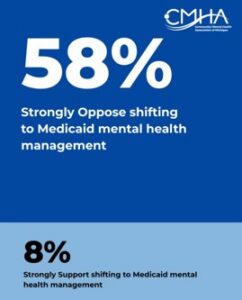
As part of the media relations segment of CMHA’s advocacy in opposition to the PIHP bid out, CMHA developed and purchased advertisement space in both Gongwer and MIRS, the two most respected Capitol news services, featuring the Open Letter from a broad and diverse set of stakeholders expressing their opposition to the bid out. That advertisement is below (albeit without the link to the letter – the letter which CMHA members have already seen)

A flyer urges support to protect Michigan’s public mental health system, highlighting an RFP from MDHHS and inviting readers to join in withdrawing the proposal.

Following is the language utilized upon distribution:

“We are excited to share with you the linked Guidance Recommendations for Supervision of School-Based Mental Health Clinicians .  This guidance document is a collaborative work between MDE, MDHHS and the Community Mental Health Association of Michigan (CMHA-Mi) intended to provide your program with recommendations related to supervision for school-based mental health providers. Feel free to share this resource with your colleagues including administrators and providers.”

CMHA Announces Associate Director Position

The Community Mental Health Association (CMHA) of Michigan is excited to announce the opening of our Associate Director position. This vital leadership role will help guide CMHA into its next chapter as we continue advancing Michigan’s public mental health system.

Effective November 1, 2025, Alan Bolter, our current Associate Director, will step into the role of incoming CEO of CMHA. As part of this transition, we are seeking a new Associate Director to join our leadership team and help shape the future of community mental health in Michigan.

To view the posting, apply, and learn more, visit the link below:
https://www.indeed.com/viewjob?jk=0a500bd451bc279b&from=shareddesktop_copy

The posting will remain open through November 1, 2025. Interviews are expected to be completed by the end of the year, with the new Associate Director beginning in early 2026.

CMHA issues Action Alert around privatization threat of PIHP bid out.

This week, CMHA issued another in a series of Action Alerts centered around the concerns around the MDHHS plans to bid-out the management of the state’s public mental health system. These concerns have been consistently raised since the MDHHS announcement earlier this year, by persons served, advocacy organizations, county officials, CMHA and its members, and a growing number of stakeholders.

BACKROUND: The Michigan Department of Health and Human Services (MDHHS) has recently released a Request for Proposals (RFP) to bid out the management of the state’s public mental health system. Advocates, persons served, public officials, and other stakeholders have underscored that this bid out addresses none of the real gaps in the system (funding and workforce shortages) while hurting access to quality care for Michiganders in need of mental health care and decimating the public system (the Community Mental Health (system) that has served them for the past six decades.

URGING ACTION: CMHA is urging Weekly Update readers to join in this Action Alert effort by going to the Advocacy Center/Take Action Now page on CMHA’s web site: https://cmham.org/advocacy/take-action-now/

CMHA continues to add to online resources for use by CMHA members and allies as part of multi-pronged advocacy effort

As part of its multi-component advocacy effort in opposition to the Michigan Department of Health and Human Services (MDHHS) RFP to bid out the management of the state’s public mental health system, CMHA regularly adds sound advocacy and informational resources, around this issue, to its web site. Those resources can be found at: https://cmham.org/advocacy/resources/

CMHA Continues to Highlight Facts and Dangers of PIHP Bid Out

CMHA staff recently joined the MichMash podcast to discuss the MDHHS bid out of the state’s public PIHP system. MichMash is a podcast produced by WDET Detroit Public Radio and the Gongwer News Service. Information regarding this podcast and a link to it can be found below:

MichMash digs into the big changes coming in how Michigan manages Medicaid mental health

This week on MichMash, it’s an expanded episode devoted to the Department of Health and Human Services rebid of who manages the state’s Medicaid mental health care services.

Co-hosts Zach Gorchow and Cheyna Roth talk to DHHS Director Elizabeth Hertel about why she’s leading the charge for the changes. Then they talk to Dan Cherrin, head of the Michigan Behavioral Health and Wellness Collaborative, who supports the overhaul, and Bob Sheehan, Executive Director of the Community Mental Health Association of Michigan, who opposes it.

Listen to MichMash through links to these platforms: Apple Podcasts, Spotify, Gongwer.

CMH of Ottawa County provided its community with information regarding the bid out, as part of its “Did you know” series.

Below is the link to today’s Did you know recording and the link to the CMH website where you will find a copy of the corresponding documents utilized or discussed in today’s update.

Presentation Link: https://www.youtube.com/watch?v=SQhjzhmZeq8

CMH Website Link: https://miottawa.org/cmh/did-you-know/

Registration Now Open for the NACBHDD Fall Virtual Legislative & Policy Conference 2025: October 21st – 22nd

The policy landscape is shifting, to help you navigate these changes and connect with peers, NACBHDD is proud to announce our first-ever Fall Virtual Legislative & Policy Conference.

During the conference you’ll gain insights into:

Education, Outreach & Coalition building

Federal behavioral health and I/DD policy  

State legislative sessions  

Join us via Zoom, October 21st – 22nd, 2025!

We are looking forward to seeing you!

Register here.

For any questions reach out to NACBHDD membership coordinator, gpennix@nacbhd.org

Recipient Rights Booklets

The Mental Health Code states that Community Mental Health Service Providers are required to distribute Recipient Rights Booklets to each recipient receiving services. Click here to place your order.

Connections

Connections purpose is to be an avenue for the exchange of information that includes people’s dreams, stories, concerns and successes. Its intent is to connect us all – the individuals who sit around the board room table, our customers, our administrators, caregivers, and our partners in the communities in which we live.

‘BoardWorks’ Videos Online

The CMHA BoardWorks program was developed to assist Board members in fulfilling their obligations as CMH leaders, directors of policy, and advocates for those they serve.

Get in Touch! 

Meet the Team

CMHA Board of Directors

Contact your Legislators

State & Federal Developments

Court of Claims Delivers Partial Decision — Questions Remain on Legality of RFP

The Department of Health and Human Services (DHHS) may possess legal authority to competitively bid Medicaid mental health managed care services and to reduce the number of Prepaid Inpatient Health Plans (PIHPs). However, that authority is not unlimited — and cannot be used through the RFP process to modify or supersede state law.


In Region 10 PIHP v. State of Michigan (COC Case No. 25-000143), Judge Christopher Yates affirmed that DHHS holds statutory authority to use a competitive procurement process to restructure the state’s PIHP system. Yet, the ruling also draws a crucial legal distinction: while DHHS may act within the framework of existing law, it cannot employ an RFP as a vehicle to alter the Mental Health Code or to reassign duties that state law expressly assigns to community mental health service programs (CMHSPs).

Judge Yates stated that competitive procurement aligns with federal preferences and that the DHHS’s effort to reduce the number of PIHPs is within its discretion. However, he made clear that this discretion does not extend to rewriting state law. Specifically, the Court declined to dismiss claims that challenge RFP provisions which appear to strip CMHSPs of their statutory functions or to redefine those functions as “non-delegable” PIHP responsibilities.

In his opinion, Judge Yates cautioned that:

“The MDHHS cannot exercise that discretion in a manner that renders CMHSPs unable to carry out their statutory obligations.”

This point is fundamental: an RFP cannot be used to amend, reinterpret, or circumvent state statute. The Mental Health Code remains the governing legal authority over the roles and responsibilities of CMHSPs, regional entities, and PIHPs. Administrative actions—no matter how well-intentioned—must remain consistent with those legislative directives.

Thus, while DHHS may proceed with competitive bidding and system redesign within its statutory authority, it must do so in a way that preserves the legal functions and obligations established by Michigan law. Any RFP terms or structural changes that undermine or conflict with those statutory duties risk exceeding the Department’s lawful authority and may invite further judicial intervention.

Yates did not indicate what might occur next to resolve the remaining claim.

Michigan is aiming to preserve existing Medicaid access and funding in the short term

New legislation, signed by Gov. Gretchen Whitmer, instructs the state Department of Health and Human Services (MDHHS) to request a waiver to continue assessing a tax on insurers to help pay for the state’s share of Medicaid expenses.

“As we face huge federal cuts that threaten to destabilize health care, we’re being strategic and proactive in Michigan to protect funding and stay flexible for the future,” said Whitmer, who held a press conference Monday, Oct. 13, in Kalamazoo to discuss her latest bill signing.

“Together, we will defend access to care for families and maintain a balanced, fiscally responsible budget. I’m grateful to our partners for working together to get this right for Michigan.”

Medicaid is a government-funded health insurance program for low-income individuals and families, as well as people with disabilities, children and more. Michigan receives billions of dollars each year from the federal government to administer the program.

Michigan uses an Insurance Provider Assessment tax to generate about $630 million in annual revenue, much of which is used to qualify for about $1.75 billion in federal match revenue under Traditional Medicaid and the Healthy Michigan Plan.

In July, President Donald Trump signed the “One Big Beautiful Bill Act,” which took aim at a subset of the provider tax that was perceived by the administration to be a loophole in federal rules.

The Big Beautiful Bill sought to cap state provider taxes at 6% in Fiscal Year 2027-28, before phasing the cap down to 3.5% in FY2031-32.

In September, the state House introduced House Bill 4968, which would have MDHHS request a waiver from the Centers for Medicare and Medicaid Services (CMS) to allow for continued collection and expenditure of that provider tax at current rates while the state prepares to implement required changes.

The bill passed through the legislature and went to Whitmer, who officially signed it last week along with the Fiscal Year 2025-26 budget. She held a public signing Monday.

Whitmer’s office said the state passed legislation to comply with the new federal regulatory landscape while preserving current revenue amounts and maintaining funding for health care providers statewide.

House Speaker Matt Hall, R-Richland Township, said the legislature was making smart reforms to protect Medicaid after Trump “took steps to stabilize Medicaid at the federal level.”

Senate Majority Leader Winnie Brinks, D-Grand Rapids, said the budget protects Medicaid from devastating federal cuts, “ensuring everyone is afforded the dignity of having access to care.

“With this bill, we are halting what was sure to be a catastrophic domino effect felt by all Michiganders, from kids, families, and seniors to health care workers and even to folks with private insurance,” Brinks said. “And by doing so, we have set ourselves apart as national leaders for the actions we’ve taken to safeguard Medicaid here in Michigan — and that’s certainly cause for celebration.”

Medicaid covers about 2.8 million residents, or 25% of the population, making it the state’s largest health insurer. In some rural counties, 40% or more of the population is covered by Medicaid.

Michigan is among the 40 states that have expanded Medicaid eligibility to adults with incomes up to 133% of the federal poverty line, according to the Citizens Research Council of Michigan. That’s an annual salary of about $20,345 for a family of one, or $35,444 for a family of three.

Whitmer said cuts of hundreds of billions of dollars to Medicaid would force providers in Michigan to close their doors, reduce the quality of services, and strip health insurance from millions of the most vulnerable Americans.

Federal changes to Medicaid included adding new work requirements.

Recipients who are able-bodied will be required to work at least 80 hours per month in order to continue to receive benefits, beginning in 2027. Exceptions exist for people 65 and older, parents with children younger than 14, pregnant women, and those “medically certified as physically or mentally unfit for employment.”

Amy Zaagman with the Protect MI Care Coalition called the bill signing a victory for every Michigander who believes quality, affordable health care should be within reach for all.

“By strengthening Medicaid and protecting the health coverage millions rely on, this legislation takes an important step toward making sure our state can continue to care for children, pregnant women, seniors, workers, and people with disabilities in every community,” Zaagman said.

Michigan Health Policy Forum opens registration for All Forum

The Michigan Health Policy Forum is Pleased to Present the Fall 2025 Forum

“Medicare, Medicaid, and Social Justice: Reflecting on the Ethical Implications of the Big, Beautiful Bill”

Monday, October 20, 2025
1:00PM – 3:30 PM

The Fall 2025 Michigan Health Policy Forum will be held on October 20, 2025, from 1:00 p.m. until 3:30 p.m. at Lansing Community College’s West Campus, 5708 Cornerstone Drive, Lansing, MI 48917.

Dr. Leonard Fleck, from MSU’s College of Human Medicine’s Center for Bioethics and Social Justice, will provide a presentation titled, “Medicare, Medicaid, and Social Justice: Reflecting on the Ethical Implications of the Big, Beautiful Bill”. Dr. Fleck’s presentation will focus on what policy makers, funders, system managers, providers and clinicians should keep in mind as they revise or implement policies and practices to address the service funding and eligibility challenges resulting from implementation of the Big, Beautiful Bill Act/H.R.1.

Dr. Fleck’s presentation will be followed by a panel discussion where presenters will talk about how their organizations are engaging and preparing for addressing the coming impact of the Act. The afternoon’s presentation and discussion should provide a framework for conducting that work in an ethical, equitable and thoughtful way that considers the needs of the individuals the organization serves, their staff members and the broader community.

Please note that attendance at the Fall Forum will be in-person only. Attendance will be limited and there will be no concurrent live-streaming of the event. There is no cost to attend.

We hope you will be able to join us on October 20th. If you have any questions, please contact us at mhpf@msu.edu.

Register here for the Fall 2025 Michigan Health Policy Forum

Support Your CMH PAC – Donate TODAY!

CMH PAC (Political Action Committees) gives money to candidates running for elective office who support and advocate on behalf of Michigan’s publicly funded mental health system. By making a donation to the CMH PAC, you are ensuring that issues important to mental health are not left out of the dialog in Lansing.

Interested in contributing to CMH PAC?
Donate online or mail check donations to our offices located at 507 S. Grand Ave., Lansing, MI 48933. Please make checks payable to CMH PAC.

Why Support CMH PAC? 

In the Michigan Legislature there are:

  • More new legislators due to term limits.
  • Fewer legislators with in-depth knowledge about behavioral health issues.
  • More legislative proposals that directly and indirectly impact Michigan’s publicly funded mental health system.
  • More aggressive interest groups competing for limited resources.
  • Very few legislative champions for persons with mental health, developmental/intellectual disabilities and substance use disorders.

CMH PAC helps overcome some of these obstacles by raising awareness for issues that are important to behavioral health care. The CMH PAC supports legislators/candidates who support and advocate on behalf of Michigan’s publicly funded mental health system.

Education, Sponsorship & Exhibition

DBT Summit Registration Open

The 2025 DBT Summit will be held November 6-7, 2025, at the Sheraton Grand Rapids Airport. Click here for more information

Annual Home and Community Based Waiver Conference Registration Open

The Annual Home and Community Based Waiver Conference will be held November 17-18, 2025, at the Lansing Center in Downtown Lansing. Registration is open. Click here for more information.

NACBHDD Virtual Legislative & Policy Conference – October 21-22

image

The National Association of County Behavioral Health and Developmental Disability Directors Fall Virtual Legislative & Policy Conference is one week away!

Join us for two days of dynamic discussions diving into the current federal and state landscapes! You’ll gain knowledge on the powerful role of education, outreach, and coalition building.

Exclusive Attendee Perks: 

  • A $5 Starbucks Gift Card to keep you energized!
  • Comprehensive Conference Materials
  • A Certificate of Participation (upon request) to officially recognize your professional development.

Register today for the NACBHDD Fall Virtual Legislative & Policy Conference!

Family PsychoEducation Skills Training

Family PsychoEducation Skills Training will be held November 7, 2025, at the DoubleTree by Hilton in Downtown Lansing. Click here for more information.

ACT 101 New Training Date Announced: Get Registered Today!

Nov. 6-7, 2025 – Embassy Suites, Grand Rapids, MI ~ REGISTER HERE

Registration Open! CMHA Annual Fall Conference October 27-28, 2025

Join us at the CMHA 2025 Annual Fall Conference for two days of connection, inspiration, and education in the behavioral health field. This year’s event features powerful keynotes on resilience, advocacy, caregiving, education partnerships, and the intersection of behavioral health and justice. Attendees will also have access to a wide range of educational workshops covering topics such as Michigan’s statewide crisis response initiatives, autism services, suicide prevention, school and youth mental health supports, artificial intelligence in behavioral health, substance use disorder health homes, justice system diversion strategies, legislative advocacy, peer and family supports, leadership development, and more. Register Here

CMHA Events

To search all upcoming CMHAM events, including conferences, trainings and webinars click here.

Logo with the text "Center for Mental Health Implementation Support" and two stylized mountain designs.

Center for Mental Health Implementation Support (CMHIS)

Center for Mental Health Implementation Support (CMHIS)

A group of diverse people place their hands together in a show of unity and teamwork.

CMHA has recently joined, as the Michigan partner, the Center for Mental Health Implementation Support (CMHIS) applies deep knowledge of how to sustainably implement effective mental health prevention, treatment, and recovery practices and programs to support organizations and systems in improving the lives of the people they serve.

CMHIS and its bi-regional Hubs can help your organization or system improve the delivery of mental health care by strategizing to overcome barriers and planning new program implementation from start to finish. CMHIS can help you map the course, navigate roadblocks, and provide support to ensure that the people who need it receive the excellent mental health care that providers always strive to deliver. CMHIS serves grantees funded by SAMHSA’s Center for Mental Health Services and organizations that oversee or directly provide mental health services. These organizations typically work with people with serious mental illness or serious emotional disturbance.

More information on CMHIS at: https://www.cmhisupport.org/

Text logo: "SAMHSA", abbreviation for the Substance Abuse and Mental Health Services Administration.

This project is supported by Grant Number SM090078 from the Substance Abuse and Mental Health Services Administration (SAMHSA) of the U.S. Department of Health and Human Services. Its contents are solely the responsibility of the authors and do not necessarily represent the official views of SAMHSA/HHS or the U.S. Government.

Weekly Update October 10, 2025

Association and Member Activities

Strong media coverage of Walk A Mile rally and press conference in opposition to privatization-centered PIHP bid out

CMHA and partners hold press conference in opposition to PIHP bid out; Walk A Mile Rally, held on the same day, draws large crowd: Earlier this week, a press conference was held in Lansing to underscore the large and growing opposition to the MDHHS bid out of the management of the state’s public mental health system. Those speaking at the press conference included representatives of NAMI-Michigan, Michigan Association of Counties, several persons served, a plaintiff in the lawsuit against the RFP, Senator Stabenow, and Michigan Representative Carri Rheingans (who, along with other Representatives, is sponsoring a number of bills to strengthen and protect the public mental health system). The media represented at the press conference included: Detroit News; Mid-Michigan Now; WLNS-TV; Michigan Advance; WILX-TV; Gongwer; 9&10 News; and Crain’s.

The press conference was held on the same day and immediately before the CMHA Walk a Mile rally on September 17. That rally drew over 2,500 people to the Capitol lawn from across the state. Senator Debbie Stabenow joined a number of speakers voicing their opposition to the bid out and their support for the public mental health system.

The press coverage of these two events was very good, with the earliest stories (more news coverage to come in the days ahead). These news stories are:

Gongwer: Stabenow, mental health groups call for DHHS to scrap plans to move to competitive procurement process for PIHPs

Crains: State push to bid out mental health coverage draws fire

Mid-Michigan Now: Opposition mounts against Michigan mental health privatization plan

Mid-Michigan Now newscast (video)

WLNS Online:  https://www.wlns.com/top-stories/walk-a-mile-in-my-shoes-rally-underway-at-state-capitol/amp/

WLNS broadcast

WILX Online:  https://www.wilx.com/2025/09/17/advocates-call-streamline-michigans-proposed-mental-health-system/

Syndicated to WNEM Online:  https://www.wnem.com/2025/09/17/advocates-call-streamline-michigans-proposed-mental-health-system/

The most recent media story, an exhaustive story, is in the Detroit News:

Detroit News:  Privatizing state’s mental health services is meant to aid care. Critics fear the opposite

Work of OnPoint, Sanilac CMH, Lifeways, and CMH of Central Michigan highlighted in latest stories in partnership with Issue Media Group

The latest news story highlighting the innovation and successes of Michigan’s public mental health system, is made possible by the partnership of CMHA, a number of its members, and the Issue Media Group (IMG). These stories, Community mental health’s unsung heroes: Listening, walking alongside, and holding hope, which highlights the innovative work being done at OnPoint, Sanilac CMH, and Lifeways; and From Washington to Central Michigan: What Medicaid changes could mean for local mental health, which highlights the views of the leadership at CMH for Central Michigan.

This story, along with the growing list of solutions journalism stories centered around the work of Michigan’s public mental health system, can be found at: https://cmham.org/newsroom/

This partnership, with the Issue Media Group (IMG), is built around the concept of “solutions journalism” – providing news about innovative and concrete ways that communities, across Michigan, are addressing the needs of their residents along a number of dimensions – healthcare, economic development, education, the arts, to name a few. Solutions journalism investigates and explains, in a critical and clear-eyed way, how people try to solve widely shared problems. While news sources and many of us typically define news as “what’s gone wrong,” solutions journalism runs counter to that definition by covering the innovative responses to identified needs and problems.

This partnership ensures that the work of Michigan’s public mental health system is highlighted in IMG’s large suite of solutions journalism-focused publications.

You can subscribe, at no cost, to these publications, on the websites of each of these publications. The list of partner publications and their websites are provided below:

Second Wave – Michigan

Capital Gains – Lansing

Catalyst Midland

Concentrate – Ann Arbor/Ypsi

Epicenter – Mount Pleasant

Flintside

Metromode – Metro Detroit

Model D

Route Bay City

Rural Innovation Exchange

Second Wave -Southwest Michigan

The Keel – Port Huron

The Lakeshore

Upword – UP

CMHA joins Kevin’s Song team in coordinating highly regarded Suicide conference

CMHA will be cooperating with the planning team for the annual Kevin’s Song conference. This conference, in its tenth year is slated for January 22 and 23, 2026 and is one of the most respected and largest conferences in the Great Lakes region focused on suicide. This new partnership has grown from the longstanding partnership which CMHA and Kevin’s Song have had over the past decade. Additional information regarding Kevin’s Song and sponsorship opportunities can be found here

CMHA, CMHA Children’s Services Workgroup, MDHHS, and MDE issue Guidance Recommendations for Supervision of school based mental health clinicians

Weekly Update readers may remember that CMHA has worked alongside the 31n state coordinators since the advent of the 31n school-based mental health program. One of the issues that was raised by CMHA and the 31n state coordinators – all of us having heard this from our local partners (CMHSPs, provider, PIHPs, local school districts, ISDs/RESAs) – was that schools could use some sound guidance on the kinds of supervision and support needed by mental health clinicians working in school settings.

Those discussions led to an effort to develop such guidance involving a workgroup made up Children’s Mental Health Services leaders from within CMHA member organizations (a group pulled together by CMHA), the 31n coordinators at the state level, and CMHA.

This effort resulted in a document “Guidance Recommendations for Supervision of School-Based Mental Health Clinicians “which was recently sent to the 31n coordinators in ISDs/RESAs across the state and the CEOs of Michigan’s CMHSPs, PIHPs, and Provider Alliance members.

CMHA wants to thank our 31n colleagues within MDE and MDHHS and the Children’s Mental Health Services workgroup who developed and championed the distribution of this document.

CMHA posts opposition advertisement in Gongwer and MIRS

As part of the media relations segment of CMHA’s advocacy in opposition to the PIHP bid out, CMHA developed and purchased advertisement space in both Gongwer and MIRS, the two most respected Capitol news services, featuring the Open Letter from a broad and diverse set of stakeholders expressing their opposition to the bid out. That advertisement is below (albeit without the link to the letter – the letter which CMHA members have already seen)

A flyer urges support to protect Michigan’s public mental health system, highlighting an RFP from MDHHS and inviting readers to join in withdrawing the proposal.

Following is the language utilized upon distribution:

“We are excited to share with you the linked Guidance Recommendations for Supervision of School-Based Mental Health Clinicians .  This guidance document is a collaborative work between MDE, MDHHS and the Community Mental Health Association of Michigan (CMHA-Mi) intended to provide your program with recommendations related to supervision for school-based mental health providers. Feel free to share this resource with your colleagues including administrators and providers.”

CMHA Announces Associate Director Position

The Community Mental Health Association (CMHA) of Michigan is excited to announce the opening of our Associate Director position. This vital leadership role will help guide CMHA into its next chapter as we continue advancing Michigan’s public mental health system.

Effective November 1, 2025, Alan Bolter, our current Associate Director, will step into the role of incoming CEO of CMHA. As part of this transition, we are seeking a new Associate Director to join our leadership team and help shape the future of community mental health in Michigan.

To view the posting, apply, and learn more, visit the link below:
https://www.indeed.com/viewjob?jk=0a500bd451bc279b&from=shareddesktop_copy

The posting will remain open through November 1, 2025. Interviews are expected to be completed by the end of the year, with the new Associate Director beginning in early 2026.

CMHA issues Action Alert around privatization threat of PIHP bid out.

This week, CMHA issued another in a series of Action Alerts centered around the concerns around the MDHHS plans to bid-out the management of the state’s public mental health system. These concerns have been consistently raised since the MDHHS announcement earlier this year, by persons served, advocacy organizations, county officials, CMHA and its members, and a growing number of stakeholders.

BACKROUND: The Michigan Department of Health and Human Services (MDHHS) has recently released a Request for Proposals (RFP) to bid out the management of the state’s public mental health system. Advocates, persons served, public officials, and other stakeholders have underscored that this bid out addresses none of the real gaps in the system (funding and workforce shortages) while hurting access to quality care for Michiganders in need of mental health care and decimating the public system (the Community Mental Health (system) that has served them for the past six decades.

URGING ACTION: CMHA is urging Weekly Update readers to join in this Action Alert effort by going to the Advocacy Center/Take Action Now page on CMHA’s web site: https://cmham.org/advocacy/take-action-now/

CMHA continues to add to online resources for use by CMHA members and allies as part of multi-pronged advocacy effort

As part of its multi-component advocacy effort in opposition to the Michigan Department of Health and Human Services (MDHHS) RFP to bid out the management of the state’s public mental health system, CMHA regularly adds sound advocacy and informational resources, around this issue, to its web site. Those resources can be found at: https://cmham.org/advocacy/resources/

CMHA Continues to Highlight Facts and Dangers of PIHP Bid Out

CMHA staff recently joined the MichMash podcast to discuss the MDHHS bid out of the state’s public PIHP system. MichMash is a podcast produced by WDET Detroit Public Radio and the Gongwer News Service. Information regarding this podcast and a link to it can be found below:

MichMash digs into the big changes coming in how Michigan manages Medicaid mental health

This week on MichMash, it’s an expanded episode devoted to the Department of Health and Human Services rebid of who manages the state’s Medicaid mental health care services.

Co-hosts Zach Gorchow and Cheyna Roth talk to DHHS Director Elizabeth Hertel about why she’s leading the charge for the changes. Then they talk to Dan Cherrin, head of the Michigan Behavioral Health and Wellness Collaborative, who supports the overhaul, and Bob Sheehan, Executive Director of the Community Mental Health Association of Michigan, who opposes it.

Listen to MichMash through links to these platforms: Apple Podcasts, Spotify, Gongwer.

CMH of Ottawa County provided its community with information regarding the bid out, as part of its “Did you know” series.

Below is the link to today’s Did you know recording and the link to the CMH website where you will find a copy of the corresponding documents utilized or discussed in today’s update.

Presentation Link: https://www.youtube.com/watch?v=SQhjzhmZeq8

CMH Website Link: https://miottawa.org/cmh/did-you-know/

Registration Now Open for the NACBHDD Fall Virtual Legislative & Policy Conference 2025: October 21st – 22nd

The policy landscape is shifting, to help you navigate these changes and connect with peers, NACBHDD is proud to announce our first-ever Fall Virtual Legislative & Policy Conference.

During the conference you’ll gain insights into:

Education, Outreach & Coalition building

Federal behavioral health and I/DD policy  

State legislative sessions  

Join us via Zoom, October 21st – 22nd, 2025!

We are looking forward to seeing you!

Register here.

For any questions reach out to NACBHDD membership coordinator, gpennix@nacbhd.org

Recipient Rights Booklets

The Mental Health Code states that Community Mental Health Service Providers are required to distribute Recipient Rights Booklets to each recipient receiving services. Click here to place your order.

Connections

Connections purpose is to be an avenue for the exchange of information that includes people’s dreams, stories, concerns and successes. Its intent is to connect us all – the individuals who sit around the board room table, our customers, our administrators, caregivers, and our partners in the communities in which we live.

‘BoardWorks’ Videos Online

The CMHA BoardWorks program was developed to assist Board members in fulfilling their obligations as CMH leaders, directors of policy, and advocates for those they serve.

Get in Touch! 

Meet the Team

CMHA Board of Directors

Contact your Legislators

State & Federal Developments

Court of Claims hears oral arguments on PIHP rebid lawsuit against DHHS, decision expected next week 

A full day of arguments and testimony in a lawsuit seeking to block the Department of Health and Human Services from rebidding prepaid inpatient health plans ended Thursday evening with a judge saying he’ll likely skip ruling on a request for preliminary injunction and issue a declaratory judgment early next week to resolve the case

Court of Claims Judge Christopher Yates said he plans to have an opinion prepared to publicize in Region 10 PIHP v. State of Michigan on Tuesday, Oct. 14. The lawsuit was brought in response to DHHS issuing an August request for proposals, or RFP, from entities to bid as new PIHPs covering mental and behavioral health care for patients with specialty needs. The RFP outlined new parameters for PIHP bidders which plaintiffs say violate the Mental Health Code and cause irreparable harm to the community mental health system many Michiganders rely on.

Currently, the state has 10 regions under DHHS, each managed by a PIHP charged with disbursing Medicaid funds to county mental health agencies and monitoring compliance with state and federal law. In the RFP, DHHS’s new parameters reduce the number of regions to three and, in effect, prevent the existing 10 PIHPs from bidding because PIHPs, under statute, only have authority in their service areas.

The lawsuit asserts DHHS drew the three new regions so that none of the existing PIHPs had a matching service area. One covers Macomb, Oakland and Wayne counties, all of which currently have their own PIHP. Another covers the Lower Peninsula from Mason, Lake, Osceola, Clare, Gladwin and Arenac counties south to the state line. The other covers the Upper Peninsula and the rest of the Lower Peninsula.

Some mental health groups have argued that the rebid of PIHPs constitutes privatization of the community mental health system, an argument DHHS has rejected since public entities are allowed to submit bids. However, since the 10 existing PIHPs cannot cover the service areas outlined in the new RFP, they’re effectively locked out of the bidding process unless they completely restructure themselves under new entities.

Plaintiff attorneys argued Thursday that since the deadline for bids to be submitted to DHHS for consideration is Monday, October 13, at which time Yates will still be deliberating, the currently existing PIHPs would effectively cease to exist if the declaratory judgement doesn’t go their way. The RFP sets an October 2026 deadline for new PIHPs to officially take effect, but attorneys for the current 10 said continuity of care cannot be guaranteed for all patients in the interim if Yates allows DHHS to move forward with its rebidding next week.

DHHS attorneys argued that the Mental Health Code and additional statutes give the department sweeping authority to select and approve PIHPs, with or without the consent of community mental health agencies.

“The Legislature clearly delegated that responsibility to DHHS, so whether any of us in this room agree with the policy changes or not, it doesn’t make them illegal,” the department’s lead counsel said in a closing statement to Yates.

Yates pressed both parties throughout the day with questions and requests for further information and said on multiple occasions that both sides had valid claims. He admitted to believing DHHS’s decision to issue the RFP was a poor one but acknowledged his policy opinion has no bearing on the legal facts of the suit or his decision.

“I don’t know whether it’s good news or bad news for you,” he said while addressing departmental attorneys before sending the courtroom home for the day, “that I think this is terribly unwise but quite probably legal.”

Whitmer signs budget, road funding bills

On Tuesday, Gov. Gretchen Whitmer signed both the general and school aid omnibus budget bills into law.

In a Lansing event closed to the press and the public, the governor was joined by legislative leadership and others to officially close the lid on the 2025-26 fiscal year budget. SB 166, the education omnibus, became PA 15, and HB 4706, for state departments and agencies, became PA 22.

Whitmer emphasized the budget’s bipartisan nature and the work it took to achieve a deal under extenuating circumstances at the state and federal level but did not mention its lateness in her statement announcing the signing.

“Our budget fixes the damn roads, cuts taxes for seniors and working families, funds first responders, secures core health care services that millions of Michiganders rely on, protects our air, lakes and land and increases government efficiency to saves taxpayers time and money,” Whitmer said. “I’m so grateful to legislators on both sides of the aisle for coming together to get this done. Amidst so much uncertainty caused by a chaotic tariff strategy and a national government shutdown, Michigan is showing everyone how to get things done. In the weeks and months ahead, we will build on this momentum and come together on commonsense tools to create and retain good-paying jobs.”

Senate Majority Leader Winnie Brinks, D-Grand Rapids, and House Speaker Matt Hall, R-Richland Township, similarly trumpeted the budget’s affordability and road funding aspects in their statements and shied away from explicitly referencing the months of chaos and gridlock which made it late to both statutory and constitutional deadlines.

“While this budget cycle featured unprecedented challenges, it also provided us the opportunity to show the rest of the country what leadership can look like in divisive political times,” Brinks said. “The result: a bipartisan budget that fixes our roads, strengthens public schools, protects health care access and insulates us from some of the toughest federal cuts. Michiganders and their communities stand to benefit both immediately and into the future because of groundwork we are laying today.”

Hall, a minority in the negotiations despite being the leader of the majority in his chamber, continued to highlight the areas within the bills that Republicans were able to win by keeping from their own proposals, much of which were left on the cutting room floor, like certain state staffing and spending reductions and ending taxes on tips and overtime pay.

“People are frustrated when they struggle to pay their bills while the government burns through billions of dollars of their money like it’s nothing. Our state government spending has grown way beyond its means, and it’s time to rein it in,” Hall said in his statement. “This budget makes a significant difference in eliminating waste, fraud and abuse to lower state spending and give the taxpayers better value for their dollars. That’s how we were finally able to get our local roads fixed and pass the public safety trust fund, all while eliminating taxes on tips, overtime and social security. You can do a lot when you take the time to evaluate state spending and set better priorities.”

State Budget Director Jen Flood said in a statement that securing a balanced and fiscally responsible budget under divided government is something lawmakers can be proud of.

“In Michigan, we’re proving that both sides can come together to do hard things, and I’m proud of the budget. It fixes the damn roads, protects Medicaid coverage for more than 2 million Michiganders, and invests in our kids from pre-k through college,” Flood said. “At a time when families are dealing with higher costs, this budget builds on our record of fiscal responsibility by paying down debt and cutting taxes for seniors and working families.”

Whitmer also signed key revenue bills which accompanied the budget today, including those related to provider, marijuana and fuel taxes and decoupling state and federal business taxes.

FY26 Budget Passes the Legislature

The House and Senate passed a $52 million spending plan for state government last night – the House vote was 101-8, and the Senate vote was 31-5.

No votes came from Reps. Gregory ALEXANDER (R-Carsonville)Timothy BESON (R-Bay City)Steve CARRA (R-Three Rivers)James DESANA (R-Carleton)Phil GREEN (R-Millington)Jaime GREENE (R-Richmond)Brad PAQUETTE (R-Niles) and Dylan WEGELA (D-Garden City). Rep. Karen WHITSETT (D-Detroit) was absent.

On the Senate side, the no votes came from Sens. Thomas ALBERT (R-Lowell)Joseph BELLINO JR. (R-Monroe)Jonathan LINDSEY (R-Coldwater)Aric NESBITT (R-Lawton) and Jim RUNESTAD (R-White Lake).

The Fiscal Year (FY) 2026 omnibus spending bill is $7 billion smaller overall and $360 million smaller in General Fund spending due, in part, to a loss in federal funding. Legislative earmarks went from $815 million two years ago in FY 2024 to $120 million.

Republicans and Democrats both claimed wins. For Republicans, the budget is slightly smaller and includes fewer “ghost” state employees. It addresses the empty state office buildings, puts more funding into the roads and creates a transparent process for the legislative earmarks.

For Democrats, the free breakfast and lunch programs in K-12 school remains. Investments in health care, low-income housing and the social safety net also remain. The Senate also saw 25 percent increases in “at-risk” funding for high-poverty school districts and more money for English learners.

The big news from the budget, however, is the 25 percent cut ($690.7 million) to the Department of Labor and Economic Opportunity, which saw the complete deletion of money from the Strategic Outreach and Attraction Reserve (SOAR) Fund, a grant program designed to attract large corporate developments.

Other pieces of note from the omnibus spending bill, HB 4706 include:

  • No deposit in the Rainy-Day Fund
  • The elimination of more than 2,000 unfilled full-time employee positions, including 827 in the Department of Health and Human Services (DHHS) budget and 453 in the Department of Corrections budget.
  • Constitutional revenue sharing is down $63 million and statutory revenue sharing is flat, but in its place is $95 million in grants to public safety, firefighters and prosecutors.
  • Instead of mandating that all state employees return to the office, the state must make sure each state building is at least 80% occupied, or it’s to be sold.
  • The House’s attempt to ban state or federal funding from being used on services, grants or programming for foreign residents not in the country legally did not make the budget.
  • State departments will be required to submit their annual strategic plan as opposed to doing a scorecard on key metrics, as the House wanted.
  • Continues the practice of state department and agency directors making sure geographically disadvantaged businesses compete for contracts.
  • The House Fiscal Agency (HFA) report lists $1 billion in additional spending at this point in time.
  • The Selfridge Air base received an additional $26 million.
  • Diversity, equity and inclusion initiatives were not banned, as the House attempted to do.
  • Departments would have to disclose private or other third-party funding they receive.
  • Contractors and subcontractors would have to use the E-Verify system to prove that their workers are legally authorized to work in the U.S.

While many departments face modest reductions, the most significant changes are centered on the Michigan Department of Health and Human Services (MDHHS), which sees substantial shifts due to federal funding declines.

MDHHS Budget Highlights

  • Overall Reduction: MDHHS gross funding is cut by 2% ($7.62 billion), largely the result of federal cuts.
  • Federal Funding Decline: The bulk of this decrease — $5.87 billion — comes from reduced federal contributions.
  • General Fund Support: To partly offset these losses, the state’s General Fund allocation to MDHHS will rise by 2% ($415 million).
  • Provider Tax Changes: Driven by federal policy changes (One Big Beautiful Bill Act), $6 billion tied to provider taxes is removed. Instead, contingency funds are created in boilerplate:
    • $2.55 billion for the hospital qualified assurance assessment program.
    • $2.4 billion for the insurance provider assessment.
  • Supplemental Funding: The bill includes $2.57 billion in supplemental funds for FY 2024–25, with $754.4 million from the General Fund.

In summary, the MDHHS budget reflects a sharp gross funding drop primarily due to federal spending reductions. The state is attempting to cushion the impact with increased General Fund dollars and by restructuring provider-related funding into contingency mechanisms, but overall, the department faces the largest contraction among all state agencies.

Specific Mental Health/Substance Abuse Services Line items


                                                                     FY’25 (Final)              FY’26(Exec Rec)        FY’26(House)            FY’26 (Conference)


-CMH Non-Medicaid services                     $125,578,200              $125,578,200              $125,578,200              $125,578,200

-Medicaid Mental Health Services           $3,387,066,600          $3,422,415,900          $3,352,643,500          $3,188,847,900

-Medicaid Substance Abuse services      $95,650,100                $98,752,100                $88,323,300                $96,323,300

-State disability assistance program        $2,018,800                  $2,018,800                   $2,018,800                   $2,018,800

-Community substance abuse                    $79,626,200                $80,207,900                $78,626,200                $79,207,900

(Prevention, education, and treatment

programs)

-Health Homes                                                  $53,418,500                $53,239,800                $25,000,000                $50,239,800

Program

-Autism services                                               $329,620,000              $458,715,500              $467,644,200              $467,644,200

-Healthy MI Plan (Behavioral health)      $527,784,600              $535,508,300              $531,044,900              $438,267,500

-CCBHC                                                                 $525,913,900              $916,062,700              $565,286,700              $916,062,700

-Total Local Dollars                                         $10,190,500               $9,943,600                   $246,900                      $9,943,600

Other Highlights of the FY26 Final Budget (Conference Report):

There is NO PIHP procurement language included – either to withdraw the RFP (as we pushed for) or the House language which allowed the RFP to move forward, the FY26 remains silent on the issue.

Sec. 1009. Medicaid Behavioral Health RFP – NOT INCLUDED

House requires the Medicaid behavioral health RFP to include specific performance measures of improved behavioral health outcomes, conflict of interest provisions, uniform standards and reduced administrative costs; requires a report on the process and rationale DHHS used to award the new contracts. Conference does not include.

PIHP Funding to One-Time Basis (NOT INLCUDED)

Conference report did NOT include the House proposal to transfer 6 Medicaid PIHP behavioral health services line items from the ongoing Behavioral Health Services unit to the One-Time Basis unit. Line items include, Autism Services, CCBHCs, Health Homes, Healthy Michigan Plan – Behavioral Health, Medicaid Mental Health Services, and Medicaid Substance Use Disorder Services.

Certified Community Behavioral Health Clinics (CCBHCs)

Conference report concurs with the Executive budget and adds $39.3 million Gross ($6.3 million GF/GP) for utilization and cost adjustments for the CCBHC demonstration program. Also includes a net $0 transfer of $350.8 million Gross ($75.7 million GF/GP) of base CCBHC payments currently within the Medicaid Mental Health and Healthy Michigan Plan – Behavioral Health lines into the supplemental payments CCBHC line.

Budget does include language – Sec. 1002 — CCBHC Demonstration
Department may not use funds to expand the CCBHC demonstration.

Medicaid Direct Care Agency Rate Reduction (NOT INCLUDED)

Conference report did NOT include the House proposal to reduce $215.8 million Gross ($74.9 million GF/GP) from reducing the direct care agency rates by $4.56 per hour. Rate reduction would have to come from agency overhead costs and not from direct care work wages paid through agencies.

Medicaid Methadone Rate Reduction (NOT INCLUDED)

Conference report did NOT include the House proposal to reduce $16.0 million Gross ($4.0 million GF/GP) to reduce the Medicaid methadone reimbursement rates from boilerplate section 965.

Medicaid Mental Health Local Match (NOT INCLUDED)

Conference report did NOT include the House proposal to remove $9.9 million of local funding, and associated federal reimbursement, used for Medicaid mental health services. Local funds were originally added to increase Medicaid mental health rates. Section 928 is related boilerplate.

Behavioral Health Lapse Savings

Conference report reduces a total of $4.0 million GF/GP from health homes ($3.0 million) and community substance use disorder($1.0 million).

Medicaid Pre-Release Services Demonstration (NOT INCLUDED)

Conference report did NOT include the Executive proposal to include $40.0 million Gross ($20.0 million GF/GP) for startup costs for correctional and other facilities, staffing, outreach, and IT costs of a new Medicaid demonstration program to provide 90 days of Medicaid covered pre-release services, including: case management, medication assisted treatment, pharmaceutical services, practitioner services, and diagnostics. Services that would begin in the following fiscal year.

Autism Benefit Managed Care Carve-Out (NOT INCLUDED)

Conference report did NOT include the Senate proposal to transfer $25.0 million Gross ($8.7 million GF/GP, which is a net GF/GP increase of $2.6 million GF/GP) from the CCBHC line for the department to make payments to PIHPs and CMHSPs for autism services outside of the managed care per-capita payment process.

BOILERPLATE SECTIONS

Sec. 902. Contracts Between DHHS and CMHSPs/PIHPs – RETAINED Requires final authorizations to CMHSPs or PIHPs be made upon the execution of contracts between DHHS and CMHSPs or PIHPs; requires DHHS to report if there are new contracts or amendments to contracts with CMHSPs or PIHPs that would affect rates or expenditures. (Document from the State Budget Office dated September 3 noted this section is unenforceable.)

Sec. 912. Salvation Army Harbor Light Program – RETAINED Requires DHHS to contract with the Salvation Army Harbor Light Program for providing non-Medicaid substance use disorder services, if program meets standard of care. (Document from the State Budget Office dated September 3 noted this section is unenforceable.)

Sec. 917. Michigan Opioid Healing and Recovery Fund and Report – REVISED Conference revises by updating allocation to $55.0 million and outlines distributions. (Sec. 1930. outlines the distribution of the one-time portion.)

Sec. 920. Rate-Setting Process for PIHPs – RETAINED Requires the Medicaid rate-setting process for PIHPs include any state and federal wage and compensation increases.

Sec. 924. Autism Services Fee Schedule – RETAINED Requires DHHS to maintain a fee schedule for autism services by not allowing expenditures used for actuarially sound rate certification to exceed the identified fee schedule, also sets behavioral technician fee schedule at not less than $66.00 per hour. (Document from the State Budget Office dated September 3 noted this section is unenforceable.)

Sec. 994. National Accreditation Review Criteria for Behavioral Health Services – NEW House requires DHHS to seek, if necessary, a federal waiver to allow a CMHSP, PIHP, or subcontracting provider agency that is reviewed and accredited by a national accrediting entity for behavioral health care services to be in compliance with state program review and audit requirements; requires a report that lists each CMHSP, PIHP, and subcontracting provider agency that is considered in compliance with state requirements; requires DHHS to continue to comply with state and federal law not initiate an action by negatively impacts beneficiary safety; defines “national accrediting entity.” Conference concurs with updated reporting dates.

Sec. 1002. CCBHC Organization Criteria – REVISED Language now states that Department may not use funds to expand the CCBHC demonstration.

Sec. 1003. Policies and Procedures for PIHPs or CMHSPs – RETAINED Requires DHHS to notify the Community Mental Health Association of Michigan when developing policies and procedures that will impact PIHPs or CMHSPs.

Sec. 1005. Health Home Programs – RETAINED Requires DHHS to maintain the number of behavioral health homes in PIHP regions and the number of opioid health homes in PIHP regions, and permits expansion into additional PIHP regions; requires a report. House revises to require any expansions to be made through the submission of a request to the legislature.

Sec. 1007. Autism Benefit Carve-Out – NOT INCLUDED Senate requires DHHS to make payments for autism services separate from per-capita payments to PIHPs and CMHSP.

Sec. 1009. Medicaid Behavioral Health RFP – NOT INCLUDED House requires the Medicaid behavioral health RFP to includes specific performance measures of improved behavioral health outcomes, conflict of interest provisions, uniform standards and reduced administrative costs; requires a report on the process and rationale DHHS used to award the new contracts.

Sec. 1034. PIHP Performance Incentives – NEW House conditions eligibility of PIHP performance incentives funded in part 1 on compliance with the provider rates for autism services and direct care in section 924 and 1031; requires the inspector general to audit claims and utilization data to verify compliance. Conference requires DHHS to seek CMS approval to condition PIHP performance incentives on compliance with the provider rates for autism services and direct care in section 924 and 231.

Sec. 1051. Third-Party Payments and Revenue Recapture Project – RETAINED Requires DHHS to continue a revenue recapture project to generate additional third-party revenue from cases that are closed or inactive.

Michigan Health Policy Forum opens registration for All Forum

The Michigan Health Policy Forum is Pleased to Present the Fall 2025 Forum

“Medicare, Medicaid, and Social Justice: Reflecting on the Ethical Implications of the Big, Beautiful Bill”

Monday, October 20, 2025
1:00PM – 3:30 PM

The Fall 2025 Michigan Health Policy Forum will be held on October 20, 2025, from 1:00 p.m. until 3:30 p.m. at Lansing Community College’s West Campus, 5708 Cornerstone Drive, Lansing, MI 48917.

Dr. Leonard Fleck, from MSU’s College of Human Medicine’s Center for Bioethics and Social Justice, will provide a presentation titled, “Medicare, Medicaid, and Social Justice: Reflecting on the Ethical Implications of the Big, Beautiful Bill”. Dr. Fleck’s presentation will focus on what policy makers, funders, system managers, providers and clinicians should keep in mind as they revise or implement policies and practices to address the service funding and eligibility challenges resulting from implementation of the Big, Beautiful Bill Act/H.R.1.

Dr. Fleck’s presentation will be followed by a panel discussion where presenters will talk about how their organizations are engaging and preparing for addressing the coming impact of the Act. The afternoon’s presentation and discussion should provide a framework for conducting that work in an ethical, equitable and thoughtful way that considers the needs of the individuals the organization serves, their staff members and the broader community.

Please note that attendance at the Fall Forum will be in-person only. Attendance will be limited and there will be no concurrent live-streaming of the event. There is no cost to attend.

We hope you will be able to join us on October 20th. If you have any questions, please contact us at mhpf@msu.edu.

Register here for the Fall 2025 Michigan Health Policy Forum

Support Your CMH PAC – Donate TODAY!

CMH PAC (Political Action Committees) gives money to candidates running for elective office who support and advocate on behalf of Michigan’s publicly funded mental health system. By making a donation to the CMH PAC, you are ensuring that issues important to mental health are not left out of the dialog in Lansing.

Interested in contributing to CMH PAC?
Donate online or mail check donations to our offices located at 507 S. Grand Ave., Lansing, MI 48933. Please make checks payable to CMH PAC.

Why Support CMH PAC? 

In the Michigan Legislature there are:

  • More new legislators due to term limits.
  • Fewer legislators with in-depth knowledge about behavioral health issues.
  • More legislative proposals that directly and indirectly impact Michigan’s publicly funded mental health system.
  • More aggressive interest groups competing for limited resources.
  • Very few legislative champions for persons with mental health, developmental/intellectual disabilities and substance use disorders.

CMH PAC helps overcome some of these obstacles by raising awareness for issues that are important to behavioral health care. The CMH PAC supports legislators/candidates who support and advocate on behalf of Michigan’s publicly funded mental health system.

Education, Sponsorship & Exhibition

Save the Date: Annual Home and Community Based Waiver Conference

The Annual Home and Community Based Waiver Conference will be held November 17-18, 2025 at the Lansing Center in Downtown Lansing. Registration will open soon.

Family PsychoEducation Skills Training

Family PsychoEducation Skills Training will be held November 7, 2025, at the DoubleTree by Hilton in Downtown Lansing. Click here for more information.

ACT 101 New Training Date Announced: Get Registered Today!

Nov. 6-7, 2025 – Embassy Suites, Grand Rapids, MI ~ REGISTER HERE

Registration Open! CMHA Annual Fall Conference October 27-28, 2025

Join us at the CMHA 2025 Annual Fall Conference for two days of connection, inspiration, and education in the behavioral health field. This year’s event features powerful keynotes on resilience, advocacy, caregiving, education partnerships, and the intersection of behavioral health and justice. Attendees will also have access to a wide range of educational workshops covering topics such as Michigan’s statewide crisis response initiatives, autism services, suicide prevention, school and youth mental health supports, artificial intelligence in behavioral health, substance use disorder health homes, justice system diversion strategies, legislative advocacy, peer and family supports, leadership development, and more. Register Here

CMHA Events

To search all upcoming CMHAM events, including conferences, trainings and webinars click here.

Logo with the text "Center for Mental Health Implementation Support" and two stylized mountain designs.

Center for Mental Health Implementation Support (CMHIS)

Center for Mental Health Implementation Support (CMHIS)

A group of diverse people place their hands together in a show of unity and teamwork.

CMHA has recently joined, as the Michigan partner, the Center for Mental Health Implementation Support (CMHIS) applies deep knowledge of how to sustainably implement effective mental health prevention, treatment, and recovery practices and programs to support organizations and systems in improving the lives of the people they serve.

CMHIS and its bi-regional Hubs can help your organization or system improve the delivery of mental health care by strategizing to overcome barriers and planning new program implementation from start to finish. CMHIS can help you map the course, navigate roadblocks, and provide support to ensure that the people who need it receive the excellent mental health care that providers always strive to deliver. CMHIS serves grantees funded by SAMHSA’s Center for Mental Health Services and organizations that oversee or directly provide mental health services. These organizations typically work with people with serious mental illness or serious emotional disturbance.

More information on CMHIS at: https://www.cmhisupport.org/

Text logo: "SAMHSA", abbreviation for the Substance Abuse and Mental Health Services Administration.

This project is supported by Grant Number SM090078 from the Substance Abuse and Mental Health Services Administration (SAMHSA) of the U.S. Department of Health and Human Services. Its contents are solely the responsibility of the authors and do not necessarily represent the official views of SAMHSA/HHS or the U.S. Government.

Weekly Update October 3, 2025

Association and Member Activities

Strong media coverage of Walk A Mile rally and press conference in opposition to privatization-centered PIHP bid out

CMHA and partners hold press conference in opposition to PIHP bid out; Walk A Mile Rally, held on the same day, draws large crowd: Earlier this week, a press conference was held in Lansing to underscore the large and growing opposition to the MDHHS bid out of the management of the state’s public mental health system. Those speaking at the press conference included representatives of NAMI-Michigan, Michigan Association of Counties, several persons served, a plaintiff in the lawsuit against the RFP, Senator Stabenow, and Michigan Representative Carri Rheingans (who, along with other Representatives, is sponsoring a number of bills to strengthen and protect the public mental health system). The media represented at the press conference included: Detroit News; Mid-Michigan Now; WLNS-TV; Michigan Advance; WILX-TV; Gongwer; 9&10 News; and Crain’s.

The press conference was held on the same day and immediately before the CMHA Walk a Mile rally on September 17. That rally drew over 2,500 people to the Capitol lawn from across the state. Senator Debbie Stabenow joined a number of speakers voicing their opposition to the bid out and their support for the public mental health system.

The press coverage of these two events was very good, with the earliest stories (more news coverage to come in the days ahead). These news stories are:

Gongwer: Stabenow, mental health groups call for DHHS to scrap plans to move to competitive procurement process for PIHPs

Crains: State push to bid out mental health coverage draws fire

Mid-Michigan Now: Opposition mounts against Michigan mental health privatization plan

Mid-Michigan Now newscast (video)

WLNS Online:  https://www.wlns.com/top-stories/walk-a-mile-in-my-shoes-rally-underway-at-state-capitol/amp/

WLNS broadcast

WILX Online:  https://www.wilx.com/2025/09/17/advocates-call-streamline-michigans-proposed-mental-health-system/

Syndicated to WNEM Online:  https://www.wnem.com/2025/09/17/advocates-call-streamline-michigans-proposed-mental-health-system/

The most recent media story, an exhaustive story, is in the Detroit News:

Detroit News:  Privatizing state’s mental health services is meant to aid care. Critics fear the opposite

Work of OnPoint, Sanilac CMH, Lifeways, and CMH of Central Michigan highlighted in latest stories in partnership with Issue Media Group

The latest news story highlighting the innovation and successes of Michigan’s public mental health system, is made possible by the partnership of CMHA, a number of its members, and the Issue Media Group (IMG). These stories, Community mental health’s unsung heroes: Listening, walking alongside, and holding hope, which highlights the innovative work being done at OnPoint, Sanilac CMH, and Lifeways; and From Washington to Central Michigan: What Medicaid changes could mean for local mental health, which highlights the views of the leadership at CMH for Central Michigan.

This story, along with the growing list of solutions journalism stories centered around the work of Michigan’s public mental health system, can be found at: https://cmham.org/newsroom/

This partnership, with the Issue Media Group (IMG), is built around the concept of “solutions journalism” – providing news about innovative and concrete ways that communities, across Michigan, are addressing the needs of their residents along a number of dimensions – healthcare, economic development, education, the arts, to name a few. Solutions journalism investigates and explains, in a critical and clear-eyed way, how people try to solve widely shared problems. While news sources and many of us typically define news as “what’s gone wrong,” solutions journalism runs counter to that definition by covering the innovative responses to identified needs and problems.

This partnership ensures that the work of Michigan’s public mental health system is highlighted in IMG’s large suite of solutions journalism-focused publications.

You can subscribe, at no cost, to these publications, on the websites of each of these publications. The list of partner publications and their websites are provided below:

Second Wave – Michigan

Capital Gains – Lansing

Catalyst Midland

Concentrate – Ann Arbor/Ypsi

Epicenter – Mount Pleasant

Flintside

Metromode – Metro Detroit

Model D

Route Bay City

Rural Innovation Exchange

Second Wave -Southwest Michigan

The Keel – Port Huron

The Lakeshore

Upword – UP

CMHA joins Kevin’s Song team in coordinating highly regarded Suicide conference

CMHA will be cooperating with the planning team for the annual Kevin’s Song conference. This conference, in its tenth year is slated for January 22 and 23, 2026 and is one of the most respected and largest conferences in the Great Lakes region focused on suicide. This new partnership has grown from the longstanding partnership which CMHA and Kevin’s Song have had over the past decade. Additional information regarding Kevin’s Song and sponsorship opportunities can be found here

CMHA, CMHA Children’s Services Workgroup, MDHHS, and MDE issue Guidance Recommendations for Supervision of school based mental health clinicians

Weekly Update readers may remember that CMHA has worked alongside the 31n state coordinators since the advent of the 31n school-based mental health program. One of the issues that was raised by CMHA and the 31n state coordinators – all of us having heard this from our local partners (CMHSPs, provider, PIHPs, local school districts, ISDs/RESAs) – was that schools could use some sound guidance on the kinds of supervision and support needed by mental health clinicians working in school settings.

Those discussions led to an effort to develop such guidance involving a workgroup made up Children’s Mental Health Services leaders from within CMHA member organizations (a group pulled together by CMHA), the 31n coordinators at the state level, and CMHA.

This effort resulted in a document “Guidance Recommendations for Supervision of School-Based Mental Health Clinicians “which was recently sent to the 31n coordinators in ISDs/RESAs across the state and the CEOs of Michigan’s CMHSPs, PIHPs, and Provider Alliance members.

CMHA wants to thank our 31n colleagues within MDE and MDHHS and the Children’s Mental Health Services workgroup who developed and championed the distribution of this document.

CMHA posts opposition advertisement in Gongwer and MIRS

As part of the media relations segment of CMHA’s advocacy in opposition to the PIHP bid out, CMHA developed and purchased advertisement space in both Gongwer and MIRS, the two most respected Capitol news services, featuring the Open Letter from a broad and diverse set of stakeholders expressing their opposition to the bid out. That advertisement is below (albeit without the link to the letter – the letter which CMHA members have already seen)

A flyer urges support to protect Michigan’s public mental health system, highlighting an RFP from MDHHS and inviting readers to join in withdrawing the proposal.

Following is the language utilized upon distribution:

“We are excited to share with you the linked Guidance Recommendations for Supervision of School-Based Mental Health Clinicians .  This guidance document is a collaborative work between MDE, MDHHS and the Community Mental Health Association of Michigan (CMHA-Mi) intended to provide your program with recommendations related to supervision for school-based mental health providers. Feel free to share this resource with your colleagues including administrators and providers.”

CMHA Announces Associate Director Position

The Community Mental Health Association (CMHA) of Michigan is excited to announce the opening of our Associate Director position. This vital leadership role will help guide CMHA into its next chapter as we continue advancing Michigan’s public mental health system.

Effective November 1, 2025, Alan Bolter, our current Associate Director, will step into the role of incoming CEO of CMHA. As part of this transition, we are seeking a new Associate Director to join our leadership team and help shape the future of community mental health in Michigan.

To view the posting, apply, and learn more, visit the link below:
https://www.indeed.com/viewjob?jk=0a500bd451bc279b&from=shareddesktop_copy

The posting will remain open through November 1, 2025. Interviews are expected to be completed by the end of the year, with the new Associate Director beginning in early 2026.

CMHA issues Action Alert around privatization threat of PIHP bid out.

This week, CMHA issued another in a series of Action Alerts centered around the concerns around the MDHHS plans to bid-out the management of the state’s public mental health system. These concerns have been consistently raised since the MDHHS announcement earlier this year, by persons served, advocacy organizations, county officials, CMHA and its members, and a growing number of stakeholders.

BACKROUND: The Michigan Department of Health and Human Services (MDHHS) has recently released a Request for Proposals (RFP) to bid out the management of the state’s public mental health system. Advocates, persons served, public officials, and other stakeholders have underscored that this bid out addresses none of the real gaps in the system (funding and workforce shortages) while hurting access to quality care for Michiganders in need of mental health care and decimating the public system (the Community Mental Health (system) that has served them for the past six decades.

URGING ACTION: CMHA is urging Weekly Update readers to join in this Action Alert effort by going to the Advocacy Center/Take Action Now page on CMHA’s web site: https://cmham.org/advocacy/take-action-now/

CMHA continues to add to online resources for use by CMHA members and allies as part of multi-pronged advocacy effort

As part of its multi-component advocacy effort in opposition to the Michigan Department of Health and Human Services (MDHHS) RFP to bid out the management of the state’s public mental health system, CMHA regularly adds sound advocacy and informational resources, around this issue, to its web site. Those resources can be found at: https://cmham.org/advocacy/resources/

CMHA Continues to Highlight Facts and Dangers of PIHP Bid Out

CMHA staff recently joined the MichMash podcast to discuss the MDHHS bid out of the state’s public PIHP system. MichMash is a podcast produced by WDET Detroit Public Radio and the Gongwer News Service. Information regarding this podcast and a link to it can be found below:

MichMash digs into the big changes coming in how Michigan manages Medicaid mental health

This week on MichMash, it’s an expanded episode devoted to the Department of Health and Human Services rebid of who manages the state’s Medicaid mental health care services.

Co-hosts Zach Gorchow and Cheyna Roth talk to DHHS Director Elizabeth Hertel about why she’s leading the charge for the changes. Then they talk to Dan Cherrin, head of the Michigan Behavioral Health and Wellness Collaborative, who supports the overhaul, and Bob Sheehan, Executive Director of the Community Mental Health Association of Michigan, who opposes it.

Listen to MichMash through links to these platforms: Apple Podcasts, Spotify, Gongwer.

CMH of Ottawa County provided its community with information regarding the bid out, as part of its “Did you know” series.

Below is the link to today’s Did you know recording and the link to the CMH website where you will find a copy of the corresponding documents utilized or discussed in today’s update.

Presentation Link: https://www.youtube.com/watch?v=SQhjzhmZeq8

CMH Website Link: https://miottawa.org/cmh/did-you-know/

Registration Now Open for the NACBHDD Fall Virtual Legislative & Policy Conference 2025: October 21st – 22nd

The policy landscape is shifting, to help you navigate these changes and connect with peers, NACBHDD is proud to announce our first-ever Fall Virtual Legislative & Policy Conference.

During the conference you’ll gain insights into:

Education, Outreach & Coalition building

Federal behavioral health and I/DD policy  

State legislative sessions  

Join us via Zoom, October 21st – 22nd, 2025!

We are looking forward to seeing you!

Register here.

For any questions reach out to NACBHDD membership coordinator, gpennix@nacbhd.org

Recipient Rights Booklets

The Mental Health Code states that Community Mental Health Service Providers are required to distribute Recipient Rights Booklets to each recipient receiving services. Click here to place your order.

Connections

Connections purpose is to be an avenue for the exchange of information that includes people’s dreams, stories, concerns and successes. Its intent is to connect us all – the individuals who sit around the board room table, our customers, our administrators, caregivers, and our partners in the communities in which we live.

‘BoardWorks’ Videos Online

The CMHA BoardWorks program was developed to assist Board members in fulfilling their obligations as CMH leaders, directors of policy, and advocates for those they serve.

Get in Touch! 

Meet the Team

CMHA Board of Directors

Contact your Legislators

State & Federal Developments

FY26 Budget Passes the Legislature

The House and Senate passed a $52 million spending plan for state government last night – the House vote was 101-8, and the Senate vote was 31-5.

No votes came from Reps. Gregory ALEXANDER (R-Carsonville)Timothy BESON (R-Bay City)Steve CARRA (R-Three Rivers)James DESANA (R-Carleton)Phil GREEN (R-Millington)Jaime GREENE (R-Richmond)Brad PAQUETTE (R-Niles) and Dylan WEGELA (D-Garden City). Rep. Karen WHITSETT (D-Detroit) was absent.

On the Senate side, the no votes came from Sens. Thomas ALBERT (R-Lowell)Joseph BELLINO JR. (R-Monroe)Jonathan LINDSEY (R-Coldwater)Aric NESBITT (R-Lawton) and Jim RUNESTAD (R-White Lake).

The Fiscal Year (FY) 2026 omnibus spending bill is $7 billion smaller overall and $360 million smaller in General Fund spending due, in part, to a loss in federal funding. Legislative earmarks went from $815 million two years ago in FY 2024 to $120 million.

Republicans and Democrats both claimed wins. For Republicans, the budget is slightly smaller and includes fewer “ghost” state employees. It addresses the empty state office buildings, puts more funding into the roads and creates a transparent process for the legislative earmarks.

For Democrats, the free breakfast and lunch programs in K-12 school remains. Investments in health care, low-income housing and the social safety net also remain. The Senate also saw 25 percent increases in “at-risk” funding for high-poverty school districts and more money for English learners.

The big news from the budget, however, is the 25 percent cut ($690.7 million) to the Department of Labor and Economic Opportunity, which saw the complete deletion of money from the Strategic Outreach and Attraction Reserve (SOAR) Fund, a grant program designed to attract large corporate developments.

Other pieces of note from the omnibus spending bill, HB 4706 include:

  • No deposit in the Rainy-Day Fund
  • The elimination of more than 2,000 unfilled full-time employee positions, including 827 in the Department of Health and Human Services (DHHS) budget and 453 in the Department of Corrections budget.
  • Constitutional revenue sharing is down $63 million and statutory revenue sharing is flat, but in its place is $95 million in grants to public safety, firefighters and prosecutors.
  • Instead of mandating that all state employees return to the office, the state must make sure each state building is at least 80% occupied, or it’s to be sold.
  • The House’s attempt to ban state or federal funding from being used on services, grants or programming for foreign residents not in the country legally did not make the budget.
  • State departments will be required to submit their annual strategic plan as opposed to doing a scorecard on key metrics, as the House wanted.
  • Continues the practice of state department and agency directors making sure geographically disadvantaged businesses compete for contracts.
  • The House Fiscal Agency (HFA) report lists $1 billion in additional spending at this point in time.
  • The Selfridge Air base received an additional $26 million.
  • Diversity, equity and inclusion initiatives were not banned, as the House attempted to do.
  • Departments would have to disclose private or other third-party funding they receive.
  • Contractors and subcontractors would have to use the E-Verify system to prove that their workers are legally authorized to work in the U.S.

While many departments face modest reductions, the most significant changes are centered on the Michigan Department of Health and Human Services (MDHHS), which sees substantial shifts due to federal funding declines.

MDHHS Budget Highlights

  • Overall Reduction: MDHHS gross funding is cut by 2% ($7.62 billion), largely the result of federal cuts.
  • Federal Funding Decline: The bulk of this decrease — $5.87 billion — comes from reduced federal contributions.
  • General Fund Support: To partly offset these losses, the state’s General Fund allocation to MDHHS will rise by 2% ($415 million).
  • Provider Tax Changes: Driven by federal policy changes (One Big Beautiful Bill Act), $6 billion tied to provider taxes is removed. Instead, contingency funds are created in boilerplate:
    • $2.55 billion for the hospital qualified assurance assessment program.
    • $2.4 billion for the insurance provider assessment.
  • Supplemental Funding: The bill includes $2.57 billion in supplemental funds for FY 2024–25, with $754.4 million from the General Fund.

In summary, the MDHHS budget reflects a sharp gross funding drop primarily due to federal spending reductions. The state is attempting to cushion the impact with increased General Fund dollars and by restructuring provider-related funding into contingency mechanisms, but overall, the department faces the largest contraction among all state agencies.

Specific Mental Health/Substance Abuse Services Line items


                                                                     FY’25 (Final)              FY’26(Exec Rec)        FY’26(House)            FY’26 (Conference)


-CMH Non-Medicaid services                     $125,578,200              $125,578,200              $125,578,200              $125,578,200

-Medicaid Mental Health Services           $3,387,066,600          $3,422,415,900          $3,352,643,500          $3,188,847,900

-Medicaid Substance Abuse services      $95,650,100                $98,752,100                $88,323,300                $96,323,300

-State disability assistance program        $2,018,800                  $2,018,800                   $2,018,800                   $2,018,800

-Community substance abuse                    $79,626,200                $80,207,900                $78,626,200                $79,207,900

(Prevention, education, and treatment

programs)

-Health Homes                                                  $53,418,500                $53,239,800                $25,000,000                $50,239,800

Program

-Autism services                                               $329,620,000              $458,715,500              $467,644,200              $467,644,200

-Healthy MI Plan (Behavioral health)      $527,784,600              $535,508,300              $531,044,900              $438,267,500

-CCBHC                                                                 $525,913,900              $916,062,700              $565,286,700              $916,062,700

-Total Local Dollars                                         $10,190,500               $9,943,600                   $246,900                      $9,943,600

Other Highlights of the FY26 Final Budget (Conference Report):

There is NO PIHP procurement language included – either to withdraw the RFP (as we pushed for) or the House language which allowed the RFP to move forward, the FY26 remains silent on the issue.

Sec. 1009. Medicaid Behavioral Health RFP – NOT INCLUDED

House requires the Medicaid behavioral health RFP to include specific performance measures of improved behavioral health outcomes, conflict of interest provisions, uniform standards and reduced administrative costs; requires a report on the process and rationale DHHS used to award the new contracts. Conference does not include.

PIHP Funding to One-Time Basis (NOT INLCUDED)

Conference report did NOT include the House proposal to transfer 6 Medicaid PIHP behavioral health services line items from the ongoing Behavioral Health Services unit to the One-Time Basis unit. Line items include, Autism Services, CCBHCs, Health Homes, Healthy Michigan Plan – Behavioral Health, Medicaid Mental Health Services, and Medicaid Substance Use Disorder Services.

Certified Community Behavioral Health Clinics (CCBHCs)

Conference report concurs with the Executive budget and adds $39.3 million Gross ($6.3 million GF/GP) for utilization and cost adjustments for the CCBHC demonstration program. Also includes a net $0 transfer of $350.8 million Gross ($75.7 million GF/GP) of base CCBHC payments currently within the Medicaid Mental Health and Healthy Michigan Plan – Behavioral Health lines into the supplemental payments CCBHC line.

Budget does include language – Sec. 1002 — CCBHC Demonstration
Department may not use funds to expand the CCBHC demonstration.

Medicaid Direct Care Agency Rate Reduction (NOT INCLUDED)

Conference report did NOT include the House proposal to reduce $215.8 million Gross ($74.9 million GF/GP) from reducing the direct care agency rates by $4.56 per hour. Rate reduction would have to come from agency overhead costs and not from direct care work wages paid through agencies.

Medicaid Methadone Rate Reduction (NOT INCLUDED)

Conference report did NOT include the House proposal to reduce $16.0 million Gross ($4.0 million GF/GP) to reduce the Medicaid methadone reimbursement rates from boilerplate section 965.

Medicaid Mental Health Local Match (NOT INCLUDED)

Conference report did NOT include the House proposal to remove $9.9 million of local funding, and associated federal reimbursement, used for Medicaid mental health services. Local funds were originally added to increase Medicaid mental health rates. Section 928 is related boilerplate.

Behavioral Health Lapse Savings

Conference report reduces a total of $4.0 million GF/GP from health homes ($3.0 million) and community substance use disorder($1.0 million).

Medicaid Pre-Release Services Demonstration (NOT INCLUDED)

Conference report did NOT include the Executive proposal to include $40.0 million Gross ($20.0 million GF/GP) for startup costs for correctional and other facilities, staffing, outreach, and IT costs of a new Medicaid demonstration program to provide 90 days of Medicaid covered pre-release services, including: case management, medication assisted treatment, pharmaceutical services, practitioner services, and diagnostics. Services that would begin in the following fiscal year.

Autism Benefit Managed Care Carve-Out (NOT INCLUDED)

Conference report did NOT include the Senate proposal to transfer $25.0 million Gross ($8.7 million GF/GP, which is a net GF/GP increase of $2.6 million GF/GP) from the CCBHC line for the department to make payments to PIHPs and CMHSPs for autism services outside of the managed care per-capita payment process.

BOILERPLATE SECTIONS

Sec. 902. Contracts Between DHHS and CMHSPs/PIHPs – RETAINED Requires final authorizations to CMHSPs or PIHPs be made upon the execution of contracts between DHHS and CMHSPs or PIHPs; requires DHHS to report if there are new contracts or amendments to contracts with CMHSPs or PIHPs that would affect rates or expenditures. (Document from the State Budget Office dated September 3 noted this section is unenforceable.)

Sec. 912. Salvation Army Harbor Light Program – RETAINED Requires DHHS to contract with the Salvation Army Harbor Light Program for providing non-Medicaid substance use disorder services, if program meets standard of care. (Document from the State Budget Office dated September 3 noted this section is unenforceable.)

Sec. 917. Michigan Opioid Healing and Recovery Fund and Report – REVISED Conference revises by updating allocation to $55.0 million and outlines distributions. (Sec. 1930. outlines the distribution of the one-time portion.)

Sec. 920. Rate-Setting Process for PIHPs – RETAINED Requires the Medicaid rate-setting process for PIHPs include any state and federal wage and compensation increases.

Sec. 924. Autism Services Fee Schedule – RETAINED Requires DHHS to maintain a fee schedule for autism services by not allowing expenditures used for actuarially sound rate certification to exceed the identified fee schedule, also sets behavioral technician fee schedule at not less than $66.00 per hour. (Document from the State Budget Office dated September 3 noted this section is unenforceable.)

Sec. 994. National Accreditation Review Criteria for Behavioral Health Services – NEW House requires DHHS to seek, if necessary, a federal waiver to allow a CMHSP, PIHP, or subcontracting provider agency that is reviewed and accredited by a national accrediting entity for behavioral health care services to be in compliance with state program review and audit requirements; requires a report that lists each CMHSP, PIHP, and subcontracting provider agency that is considered in compliance with state requirements; requires DHHS to continue to comply with state and federal law not initiate an action by negatively impacts beneficiary safety; defines “national accrediting entity.” Conference concurs with updated reporting dates.

Sec. 1002. CCBHC Organization Criteria – REVISED Language now states that Department may not use funds to expand the CCBHC demonstration.

Sec. 1003. Policies and Procedures for PIHPs or CMHSPs – RETAINED Requires DHHS to notify the Community Mental Health Association of Michigan when developing policies and procedures that will impact PIHPs or CMHSPs.

Sec. 1005. Health Home Programs – RETAINED Requires DHHS to maintain the number of behavioral health homes in PIHP regions and the number of opioid health homes in PIHP regions, and permits expansion into additional PIHP regions; requires a report. House revises to require any expansions to be made through the submission of a request to the legislature.

Sec. 1007. Autism Benefit Carve-Out – NOT INCLUDED Senate requires DHHS to make payments for autism services separate from per-capita payments to PIHPs and CMHSP.

Sec. 1009. Medicaid Behavioral Health RFP – NOT INCLUDED House requires the Medicaid behavioral health RFP to includes specific performance measures of improved behavioral health outcomes, conflict of interest provisions, uniform standards and reduced administrative costs; requires a report on the process and rationale DHHS used to award the new contracts.

Sec. 1034. PIHP Performance Incentives – NEW House conditions eligibility of PIHP performance incentives funded in part 1 on compliance with the provider rates for autism services and direct care in section 924 and 1031; requires the inspector general to audit claims and utilization data to verify compliance. Conference requires DHHS to seek CMS approval to condition PIHP performance incentives on compliance with the provider rates for autism services and direct care in section 924 and 231.

Sec. 1051. Third-Party Payments and Revenue Recapture Project – RETAINED Requires DHHS to continue a revenue recapture project to generate additional third-party revenue from cases that are closed or inactive.

What Does the Federal Government Shutdown Mean?

The U.S. government has once again entered a shutdown—the 21st in the past fifty years—after Congress failed to reach a funding agreement. Because the Senate requires 60 votes to advance spending bills, Republicans were unable to overcome a Democratic filibuster, and no compromise was reached. As a result, all non-emergency federal operations must pause until funding is restored. Essential services such as law enforcement, border security, air traffic control, and intelligence activities will continue, while many other functions—including environmental inspections, passport processing, and certain assistance programs—may be delayed or suspended. Shutdowns vary in length; the longest lasted 34 days and cost the U.S. economy billions of dollars.

Importantly, programs like Social Security, Medicare, and Medicaid remain protected. Because they are funded through mandatory spending rather than annual appropriations, these programs will continue uninterrupted. This means Medicaid beneficiaries will maintain coverage, and healthcare providers will still receive payments. For millions of low-income individuals, people with disabilities, and seniors, this protection ensures continuity of care during an otherwise uncertain time.

Still, indirect effects are still possible. Federal employees who help administer Medicaid—such as those working on eligibility verification, program oversight, or IT systems—may be furloughed, potentially causing delays in processing new applications, renewals, or appeals. State Medicaid offices, which rely on federal guidance, could also experience slower support. And if the shutdown continues for an extended period, other federally linked programs, such as food assistance or childcare subsidies, may be disrupted, creating added pressure on vulnerable families.

Michigan Health Policy Forum opens registration for All Forum

The Michigan Health Policy Forum is Pleased to Present the Fall 2025 Forum

“Medicare, Medicaid, and Social Justice: Reflecting on the Ethical Implications of the Big, Beautiful Bill”

Monday, October 20, 2025
1:00PM – 3:30 PM

The Fall 2025 Michigan Health Policy Forum will be held on October 20, 2025, from 1:00 p.m. until 3:30 p.m. at Lansing Community College’s West Campus, 5708 Cornerstone Drive, Lansing, MI 48917.

Dr. Leonard Fleck, from MSU’s College of Human Medicine’s Center for Bioethics and Social Justice, will provide a presentation titled, “Medicare, Medicaid, and Social Justice: Reflecting on the Ethical Implications of the Big, Beautiful Bill”. Dr. Fleck’s presentation will focus on what policy makers, funders, system managers, providers and clinicians should keep in mind as they revise or implement policies and practices to address the service funding and eligibility challenges resulting from implementation of the Big, Beautiful Bill Act/H.R.1.

Dr. Fleck’s presentation will be followed by a panel discussion where presenters will talk about how their organizations are engaging and preparing for addressing the coming impact of the Act. The afternoon’s presentation and discussion should provide a framework for conducting that work in an ethical, equitable and thoughtful way that considers the needs of the individuals the organization serves, their staff members and the broader community.

Please note that attendance at the Fall Forum will be in-person only. Attendance will be limited and there will be no concurrent live-streaming of the event. There is no cost to attend.

We hope you will be able to join us on October 20th. If you have any questions, please contact us at mhpf@msu.edu.

Register here for the Fall 2025 Michigan Health Policy Forum

Support Your CMH PAC – Donate TODAY!

CMH PAC (Political Action Committees) gives money to candidates running for elective office who support and advocate on behalf of Michigan’s publicly funded mental health system. By making a donation to the CMH PAC, you are ensuring that issues important to mental health are not left out of the dialog in Lansing.

Interested in contributing to CMH PAC?
Donate online or mail check donations to our offices located at 507 S. Grand Ave., Lansing, MI 48933. Please make checks payable to CMH PAC.

Why Support CMH PAC? 

In the Michigan Legislature there are:

  • More new legislators due to term limits.
  • Fewer legislators with in-depth knowledge about behavioral health issues.
  • More legislative proposals that directly and indirectly impact Michigan’s publicly funded mental health system.
  • More aggressive interest groups competing for limited resources.
  • Very few legislative champions for persons with mental health, developmental/intellectual disabilities and substance use disorders.

CMH PAC helps overcome some of these obstacles by raising awareness for issues that are important to behavioral health care. The CMH PAC supports legislators/candidates who support and advocate on behalf of Michigan’s publicly funded mental health system.

Education, Sponsorship & Exhibition

Registration Open! CMHA Annual Fall Conference October 27-28, 2025

Join us at the CMHA 2025 Annual Fall Conference for two days of connection, inspiration, and education in the behavioral health field. This year’s event features powerful keynotes on resilience, advocacy, caregiving, education partnerships, and the intersection of behavioral health and justice. Attendees will also have access to a wide range of educational workshops covering topics such as Michigan’s statewide crisis response initiatives, autism services, suicide prevention, school and youth mental health supports, artificial intelligence in behavioral health, substance use disorder health homes, justice system diversion strategies, legislative advocacy, peer and family supports, leadership development, and more. Register Here

CMHA Events

To search all upcoming CMHAM events, including conferences, trainings and webinars click here.

Logo with the text "Center for Mental Health Implementation Support" and two stylized mountain designs.

Center for Mental Health Implementation Support (CMHIS)

Center for Mental Health Implementation Support (CMHIS)

A group of diverse people place their hands together in a show of unity and teamwork.

CMHA has recently joined, as the Michigan partner, the Center for Mental Health Implementation Support (CMHIS) applies deep knowledge of how to sustainably implement effective mental health prevention, treatment, and recovery practices and programs to support organizations and systems in improving the lives of the people they serve.

CMHIS and its bi-regional Hubs can help your organization or system improve the delivery of mental health care by strategizing to overcome barriers and planning new program implementation from start to finish. CMHIS can help you map the course, navigate roadblocks, and provide support to ensure that the people who need it receive the excellent mental health care that providers always strive to deliver. CMHIS serves grantees funded by SAMHSA’s Center for Mental Health Services and organizations that oversee or directly provide mental health services. These organizations typically work with people with serious mental illness or serious emotional disturbance.

More information on CMHIS at: https://www.cmhisupport.org/

Text logo: "SAMHSA", abbreviation for the Substance Abuse and Mental Health Services Administration.

This project is supported by Grant Number SM090078 from the Substance Abuse and Mental Health Services Administration (SAMHSA) of the U.S. Department of Health and Human Services. Its contents are solely the responsibility of the authors and do not necessarily represent the official views of SAMHSA/HHS or the U.S. Government.

Back to top